
Introduction
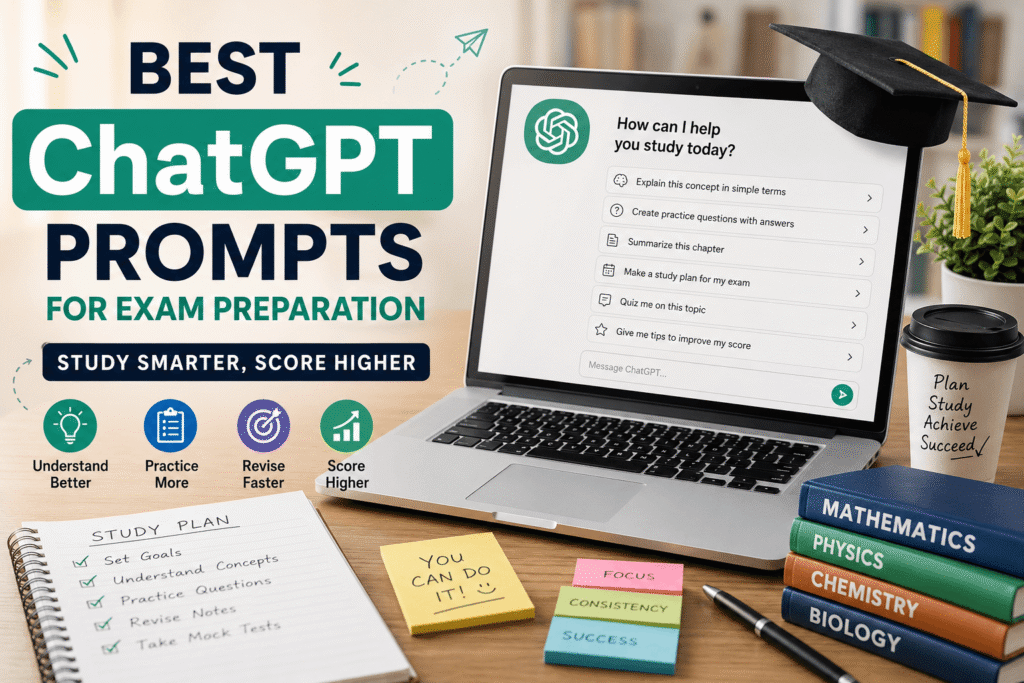
Preparing for exams can feel overwhelming, especially when you’re juggling multiple subjects, deadlines, and revision schedules. Fortunately, the Best ChatGPT Prompts for Exam Preparation can transform the way you study by helping you understand difficult concepts, organize your notes, practice questions, and revise more efficiently.
Rather than spending hours searching through textbooks or random online resources, you can use carefully crafted prompts to turn ChatGPT into your personal AI study assistant. Whether you’re a high school student, university learner, professional preparing for certification exams, or lifelong learner, the right prompts can save valuable time while improving comprehension and retention.
In this guide, you’ll discover practical prompts, effective study strategies, common mistakes to avoid, and expert tips to maximize your exam preparation using AI responsibly.
Table of Contents
- Why ChatGPT Is Changing Exam Preparation
- How ChatGPT Helps Students Learn Better
- Best ChatGPT Prompts for Exam Preparation
- Subject-Specific Prompt Examples
- Benefits of Using ChatGPT for Studying
- Best Practices for Better Results
- Common Mistakes to Avoid
- Practical Study Checklist
- Internal & External Resource Suggestions
- Frequently Asked Questions
- Final Thoughts
Why ChatGPT Is Changing Exam Preparation
Artificial intelligence is rapidly becoming an essential learning companion for students worldwide. Instead of replacing traditional studying, ChatGPT enhances learning by making information easier to understand and more personalized.
Students across the USA, Canada, the UK, and Europe increasingly use AI to:
- Simplify difficult topics
- Generate practice quizzes
- Summarize lengthy chapters
- Improve essay writing
- Create personalized revision plans
- Practice interviews
- Learn new vocabulary
- Solve mathematical problems step-by-step
- Receive instant explanations
Unlike static study guides, ChatGPT adapts its responses based on your questions, allowing every study session to become interactive and engaging.
As AI continues to evolve, students who learn how to ask better questions often achieve better learning outcomes.
How ChatGPT Helps Students Learn Better
Many students struggle because they passively read notes instead of actively engaging with the material. ChatGPT encourages active learning by prompting deeper thinking and personalized explanations.
Personalized Learning
Every student learns differently.
Instead of reading the same explanation repeatedly, you can ask ChatGPT to explain concepts using:
- Simple language
- Real-life examples
- Analogies
- Visual descriptions
- Step-by-step breakdowns
For example:
“Explain photosynthesis like I’m 12 years old.”
or
“Explain calculus using real-world examples.”
This flexibility makes learning far more accessible.
Faster Revision
Instead of rereading an entire textbook chapter, ChatGPT can create concise revision summaries.
Example Prompt:
“Summarize Chapter 5 into 15 important bullet points.”
This allows students to review large amounts of information quickly without losing the key concepts.
Practice Testing
Educational research consistently shows that self-testing improves long-term memory.
ChatGPT can instantly generate:
- Multiple-choice questions
- Short-answer questions
- True/False quizzes
- Flashcards
- Mock exams
Example Prompt:
“Create a 20-question practice exam on World War II with answers explained.”
Instant Feedback
Instant Feedback
Instead of waiting for a teacher or tutor, students can receive immediate feedback.
Prompt example:
“Review my essay and identify weak arguments, grammar mistakes, and areas for improvement.”
This speeds up the learning cycle significantly.
Best ChatGPT Prompts for Exam Preparation
The quality of your results depends heavily on the quality of your prompts. Below are some of the most effective prompts students can use.
1. Understand Difficult Concepts
Prompt
Explain [topic] in simple language with practical examples suitable for a beginner.
Example:
Explain Newton’s Laws using everyday situations.
2. Create a Personalized Study Plan
Prompt
Create a 14-day study plan for my Biology exam. I have two hours available each weekday and five hours on weekends.
This creates a realistic schedule based on your available study time.
3. Generate Practice Questions
Prompt
Create 30 exam-style questions about [subject] with detailed answers and explanations.
Excellent for testing knowledge before exam day.
4. Summarize Long Chapters
Prompt
Summarize this chapter into key concepts, important definitions, and exam points.
Perfect for quick revision.
5. Explain Mistakes
Prompt
I answered this question incorrectly. Explain why my answer is wrong and show the correct reasoning.
Learning from mistakes builds stronger understanding than simply memorizing answers.
6. Create Flashcards
Prompt
Turn these notes into question-and-answer flashcards.
Ideal for active recall.
7. Improve Essay Writing
Prompt
Evaluate my essay using university grading criteria and suggest improvements.
Useful for literature, history, law, business, and social sciences.
8. Teach Like a Tutor
Prompt
Teach me [topic] step by step. After each section, ask me questions before moving on.
This creates an interactive learning experience.
9. Compare Similar Topics
Prompt
Compare mitosis and meiosis using a simple comparison table.
Comparison prompts help eliminate confusion between similar concepts.
10. Last-Minute Revision
Prompt
I have one day before my exam. What are the highest-priority topics I should review first?
While cramming isn’t ideal, prioritization can make limited study time more effective.
Subject-Specific ChatGPT Prompt Examples
Different academic disciplines benefit from different prompting styles.
Mathematics
Try prompts like:
- Solve this equation step by step.
- Explain where I made my mistake.
- Generate similar practice problems.
- Explain this formula using real-world applications.
Science
Useful prompts include:
- Explain this process with diagrams described in words.
- Compare two scientific theories.
- Create multiple-choice questions.
- Summarize laboratory concepts.
History
Ask ChatGPT to:
- Explain historical events chronologically.
- Compare causes and consequences.
- Create revision timelines.
- Generate essay questions.
English and Literature
Helpful prompts include:
- Analyze the themes of this novel.
- Explain literary devices.
- Improve my essay structure.
- Suggest stronger arguments.
Business and Economics
Students can ask:
- Explain supply and demand using real businesses.
- Compare economic theories.
- Generate case-study questions.
Simplify financial terminology.
Benefits of Using the Best ChatGPT Prompts for Exam Preparation
Using well-designed prompts offers more than convenience—it supports smarter, more focused learning.
Improved Understanding
Complex topics become easier to grasp through personalized explanations and examples.
Better Time Management
AI can help organize study sessions, summarize materials, and prioritize tasks, reducing time spent on repetitive work.
Increased Confidence
Regular practice with quizzes, mock exams, and instant feedback helps students feel more prepared before test day.
Active Learning
Instead of passively reading notes, students engage with questions, explanations, and interactive exercises that reinforce memory.
Flexible Study Support
Whether you’re revising for school exams, university assessments, or professional certifications, ChatGPT adapts to your learning goals and pace.
Best Practices for Using the Best ChatGPT Prompts for Exam Preparation
Using ChatGPT effectively isn’t just about asking questions—it’s about asking the right questions in the right way. The more specific your prompts are, the more accurate and useful the responses will be.
Be Specific About Your Goal
Instead of asking:
“Teach me biology.”
Try:
“Explain the process of cellular respiration for a Grade 12 student using simple language and include five quiz questions at the end.”
Providing context helps ChatGPT tailor its response to your learning level and objectives.
Ask Follow-Up Questions
Treat ChatGPT like a tutor rather than a search engine. If something isn’t clear, keep the conversation going.
Examples:
- “Can you explain that with another example?”
- “Summarize this in five bullet points.”
- “Create a memory trick for this concept.”
- “Explain this as if I were preparing for a final exam.”
This conversational approach often leads to deeper understanding.
Combine AI With Trusted Learning Resources
ChatGPT works best when used alongside textbooks, lecture notes, and reputable educational websites. It can simplify concepts and generate practice material, but always verify important facts with reliable sources.
Practice Active Recall
One of the most effective study techniques is active recall—testing yourself instead of simply rereading notes.
Use prompts like:
- “Quiz me on Chapter 8 without showing the answers first.”
- “Ask me one question at a time and wait for my response.”
- “Increase the difficulty after each correct answer.”
This method strengthens long-term memory and improves exam performance.
Create Mock Exams
Simulating real exam conditions helps reduce anxiety and improves time management.
Prompt example:
“Create a 60-minute mock exam on European History with multiple-choice and essay questions. Grade my answers afterward.”
Practicing under realistic conditions builds confidence and highlights areas that need more revision.
Common Mistakes to Avoid
While ChatGPT is a powerful learning assistant, using it incorrectly can limit its effectiveness.
Using Vague Prompts
General prompts often produce general answers.
Instead of:
“Help me study.”
Try:
“Create a revision plan for my chemistry exam covering acids, bases, and chemical reactions.”
Relying Entirely on AI
ChatGPT should complement—not replace—your classroom learning, textbooks, or instructor guidance. Cross-check important information, especially for technical or academic subjects.
Memorizing Without Understanding
Understanding concepts is more valuable than memorizing answers.
Ask prompts such as:
- “Why does this formula work?”
- “Explain the reasoning behind this answer.”
- “What is the real-world application of this concept?”
Ignoring Weak Areas
Many students repeatedly review topics they already know. Instead, ask ChatGPT to identify your knowledge gaps.
Prompt:
“Based on this quiz, identify my weakest topics and create a revision plan.”
Studying Without a Schedule
Consistency beats last-minute cramming.
Prompt example:
“Build a three-week revision timetable with daily goals, review sessions, and weekly practice tests.”
Practical Checklist for Exam Preparation With ChatGPT
Before your next exam, use this checklist to make the most of AI-assisted studying:
Create a personalized study schedule.
Summarize each chapter into key points.
Generate practice quizzes.
Review incorrect answers and understand why they were wrong.
Build digital flashcards.
Practice essay writing with AI feedback.
Simulate timed mock exams.
Focus extra time on weak subjects.
Verify key facts using trusted educational sources.
Review summaries one day before the exam.
Following these steps can help you stay organized, reduce stress, and improve retention.
Take Your Learning Further With My AI Study Zone
Success in exams isn’t just about working harder—it’s about studying smarter.
If you’re looking for practical AI tutorials, productivity tips, prompt guides, and educational resources, My AI Study Zone is here to help you make the most of modern learning tools.
Whether you’re preparing for school exams, university assessments, or professional certifications, you’ll find actionable strategies to improve your study habits and confidence.
Call to Action
Ready to study more efficiently with AI?
Explore more expert guides, discover powerful ChatGPT prompts, and learn how to use artificial intelligence responsibly for education. Visit My AI Study Zone today and take the next step toward achieving your academic goals.
Frequently Asked Questions (FAQ)
What are the best ChatGPT prompts for exam preparation?
The best ChatGPT prompts for exam preparation include requests to explain concepts, generate quizzes, summarize chapters, create flashcards, develop study plans, and review essays. Specific prompts generally produce more accurate and helpful responses.
Can ChatGPT improve exam scores?
ChatGPT can improve learning by providing explanations, practice questions, revision summaries, and instant feedback. However, consistent study habits and verified learning resources remain essential for academic success.
Is ChatGPT suitable for university students?
Yes. University students can use ChatGPT for research support, concept explanations, essay planning, coding assistance, case study analysis, and exam revision. Always verify factual information with reliable academic sources.
How should I write better ChatGPT prompts?
Be clear about your subject, learning level, and desired outcome. Include details such as the topic, format, difficulty level, and whether you want examples, quizzes, or summaries.
Can ChatGPT replace teachers or textbooks?
No. ChatGPT is a valuable study assistant, but it should complement—not replace—teachers, textbooks, lectures, and trusted educational resources. Combining AI with traditional learning methods provides the best results.
Conclusion
The Best ChatGPT Prompts for Exam Preparation can transform the way students learn by making study sessions more interactive, personalized, and efficient. From generating revision plans and practice quizzes to explaining complex concepts in simple language, ChatGPT offers valuable support throughout the learning process.
The key to success lies in asking thoughtful prompts, verifying important information, and combining AI with trusted educational resources. When used responsibly, ChatGPT becomes more than just an AI chatbot—it becomes a powerful study companion that helps learners build confidence, strengthen understanding, and prepare more effectively for exams.
Whether you’re a high school student, university learner, or professional pursuing certification, integrating smart AI prompts into your study routine can help you save time, reduce stress, and achieve better academic outcomes.


Pingback: How to Summarize Research Papers Using AI
Informative
Pingback: Create Study Notes Using AI in Minutes
Pingback: What Is Generative AI? A Complete Beginner’s Guide -
Pingback: AI Ethics for Students: Is AI Homework Ethical?