using AI for homework,assignment

Is Using AI for Homework Ethical? A Complete Guide to AI Ethics for Students

Introduction

Have you ever wondered whether using ChatGPT or another AI tool to complete your homework is helping you learn—or simply helping you finish faster?

Artificial intelligence is transforming education at an unprecedented pace. Millions of students across the USA, Canada, the UK, and Europe now rely on AI-powered tools to brainstorm ideas, explain difficult concepts, summarise lengthy chapters, and even draft essays. But this rapid adoption raises an important question: Where should we draw the line?

Understanding AI ethics for students has become essential in today’s digital classroom. While AI can be an outstanding learning companion, using it without critical thinking or transparency can lead to academic dishonesty, reduced learning, and even disciplinary consequences.

In this guide, you’ll discover when using AI for homework is ethical, when it crosses into misconduct, how schools and universities are responding, and the practical steps you can take to use AI responsibly while continuing to build genuine knowledge and skills.

By the end, you’ll have a clear framework for making smarter, more ethical decisions whenever you use AI in your studies.

📌 Key Takeaways

✔ AI is a learning assistant—not a replacement for your thinking.

✔ Ethical AI use depends on how you use it, not simply whether you use it.

✔ Many schools now allow AI for learning support but prohibit submitting AI-generated work as your own.

✔ Understanding AI ethics helps protect your academic integrity and improves long-term learning.

Table of Contents

  1. What Is AI Ethics for Students?
  2. Why Ethical AI Use Matters in Education
  3. Is Using AI for Homework Ethical?
  4. Benefits of Responsible AI Usage
  5. Best Practices for Students
  6. Common Mistakes to Avoid
  7. Practical Checklist
  8. Comparison Table
  9. Case Study
  10. FAQs
  11. Conclusion

What Is AI Ethics for Students?

AI ethics for students refers to the responsible, honest, and transparent use of artificial intelligence in education. It involves using AI tools to support learning while maintaining academic integrity, respecting school policies, and ensuring that submitted work reflects the student’s own understanding.

AI ethics is no longer a topic reserved for technology professionals. It has become part of everyday education.

Whether you’re using ChatGPT to explain algebra, Grammarly to improve grammar, or an AI-powered tutor to revise biology, ethical considerations apply.

The key principle is simple:

AI should enhance learning—not replace it.

Responsible AI use means maintaining ownership of your education while benefiting from technology’s strengths.

Think of AI like a calculator.

A calculator helps solve mathematical operations efficiently, but students are still expected to understand mathematical concepts. Similarly, AI can assist with research, explanations, brainstorming, and revision, but genuine learning still depends on the student.

The Core Principles of Ethical AI Use

Responsible AI use is built on several important principles:

  • Academic honesty
  • Transparency
  • Independent thinking
  • Critical evaluation
  • Respect for school policies
  • Privacy awareness
  • Responsible fact-checking

Students who understand these principles are far more likely to benefit from AI without compromising their education.

Why Academic Integrity Still Matters

Education is about developing skills—not merely completing assignments.

Teachers assign homework because it helps students:

  • strengthen understanding
  • practise problem-solving
  • improve communication
  • build analytical thinking
  • prepare for examinations

If AI completes all the intellectual work, students may achieve good grades while missing the knowledge those grades are supposed to represent.

That’s why universities worldwide are updating academic integrity policies to address AI-assisted learning.

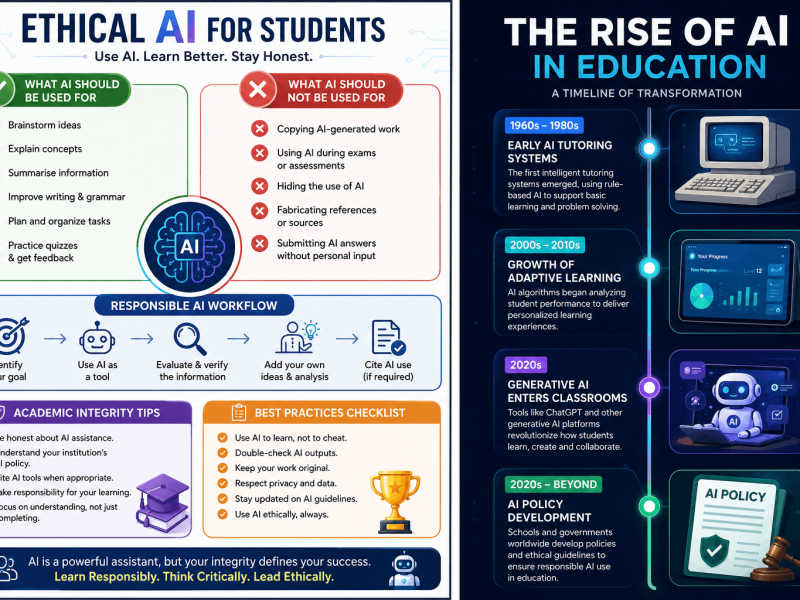
AI ethics for students infographic showing ethical and unethical AI homework practices.

Why AI Ethics for Students Matters More Than Ever

Artificial intelligence is becoming part of nearly every stage of education.

Students now use AI to:

  • understand difficult topics
  • create study schedules
  • practise foreign languages
  • generate flashcards
  • improve writing
  • prepare presentations
  • solve coding problems

While these applications can increase productivity, they also introduce new ethical challenges.

The question is no longer “Should students use AI?”

Instead, it has become:

“How should students use AI responsibly?”

This shift is reshaping classrooms around the world.

Schools Are Changing Their Policies

Many educational institutions have moved away from outright AI bans.

Instead, they now encourage responsible use by defining acceptable and unacceptable practices.

Examples include:

Generally Acceptable

  • Asking AI to explain a difficult topic
  • Creating revision questions
  • Improving grammar
  • Organising notes 
  • Brainstorming project ideas

Usually Not Acceptable

  • Generating an entire assignment
  • Completing online assessments
  • Creating fake citations
  • Using AI during examinations
  • Presenting AI work as original

Students should always review their institution’s AI policy before using AI for coursework.

AI Literacy Is Becoming an Essential Skill

Future employers increasingly expect graduates to understand AI tools.

However, employers also value:

  • critical thinking
  • creativity
  • communication
  • ethical decision-making
  • independent problem-solving

Learning to collaborate responsibly with AI is becoming just as important as learning traditional digital skills.

📊 Comparison Table

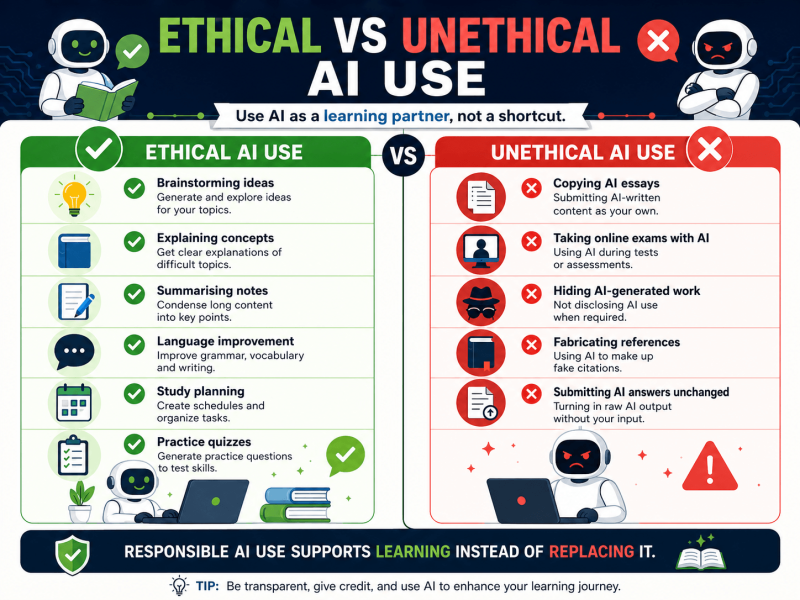
             Ethical AI Use                                                                                                     Unethical AI Use

  • Explaining difficult concepts                                                              Writing entire assignments
  • Creating study notes                                                                      Copying AI output without editing
  • Brainstorming ideas                                                                                   Using AI during exams
  • Improving grammar                                                                                  Generating fake sources
  • Practising interview questions                                            Completing graded assessments dishonestly

Expert Tip
Treat AI like a knowledgeable tutor rather than a ghostwriter. If you cannot explain the final answer in your own words, you probably relied on AI too much.

Real-World Case Study

Emma – A University Student in Canada

Emma struggled with economics.

Instead of asking ChatGPT to write her coursework, she used AI to explain supply and demand with simple examples.

After reading the explanations, she wrote her assignment herself.

She also verified the information using her textbook and lecture notes.

The result?

Better understanding
Higher confidence
Original coursework
No academic integrity concerns

Emma used AI ethically because it supported her learning rather than replacing it.

Is Using AI for Homework Ethical?

Using AI for homework is ethical when it supports learning rather than replaces it. Using AI to understand concepts, brainstorm ideas, improve writing, or check grammar is generally acceptable. However, submitting AI-generated work as your own without permission is considered unethical and may violate your school’s academic integrity policy.

The ethics of AI in education isn’t black and white. Instead, it depends on intent, transparency, and how the technology is used.

Think of AI as a calculator, dictionary, or search engine. These tools are valuable because they help students learn—not because they complete all the thinking.

Ask yourself these questions before using AI:

  • Am I learning from this response?
  • Can I explain this answer in my own words?
  • Does my school’s AI policy allow this use?
  • Am I being honest about AI assistance?
  • Would I feel comfortable telling my teacher how I used AI?

If you answer “yes” to these questions, you’re likely using AI responsibly.

When AI Use Is Ethical

Using AI is generally considered ethical when it helps you:

  • Understand difficult concepts
  • Brainstorm essay topics
  • Generate study questions
  • Create revision notes
  • Improve grammar and clarity
  • Receive feedback on your writing
  • Practise interview questions
  • Learn programming concepts
  • Translate unfamiliar vocabulary while learning a language

The key point is that the learning remains yours.

When AI Use Becomes Unethical

AI crosses ethical boundaries when students use it to avoid learning.

Examples include:

  • Copying AI-generated essays word for word
  • Completing graded quizzes using AI
  • Taking online exams with AI assistance
  • Creating fake citations or references
  • Hiding AI-generated content from instructors
  • Submitting assignments you don’t fully understand
  • These practices undermine academic integrity and can have serious consequences.

📦 Summary Box

Ethical AI Use

✔ Helps you learn

✔ Improves understanding

✔ Saves research time

✔ Encourages independent thinking

✔ Supports revision

Unethical AI Use

✖ Replaces your own work

✖ Breaks school policies

✖ Misleads teachers

✖ Prevents real learning

✖ Risks disciplinary action

Benefits of Responsible AI Ethics for Students

When used thoughtfully, AI can become one of the most powerful learning companions available.

Here are the biggest advantages of responsible AI use.

1. Personalised Learning

Every student learns differently.

AI can explain the same topic using different examples until it finally “clicks.”

For example, if algebra seems confusing, AI can explain it with:

  • sports examples
  • shopping examples
  • business scenarios
  • visual analogies

This personalised approach helps many students learn faster.

2. Faster Research

AI can summarise lengthy articles and highlight key concepts, saving valuable study time.

Instead of replacing research, it helps students identify important topics before exploring trusted academic sources.

Always verify important information using textbooks, peer-reviewed journals, or your instructor’s recommended resources.

3. Better Writing Skills

AI can provide feedback on:

  • sentence structure
  • grammar
  • readability
  • vocabulary
  • organisation

However, students should revise their own work instead of copying AI-generated text.

4. Increased Confidence

Many students hesitate to ask questions in class.

AI provides a private environment where learners can ask unlimited questions without fear of embarrassment.

This encourages curiosity and continuous improvement.

5. Improved Time Management

AI tools can help students:

  • create study schedules
  • organise assignments
  • prioritise deadlines
  • break large projects into manageable tasks

You just need to know how to give prompt to AI.

These organisational benefits allow students to spend more time learning instead of planning.

📊 Comparison Table

             Traditional Homework                                                                          AI-Assisted Homework (Ethical)

  • Research from multiple books                                                          Research plus AI explanations
  • Manual grammar checking                                                                    AI-assisted proofreading
  • Fixed study pace                                                                                       Personalised explanations
  • Limited teacher availability                                                                      24/7 learning support
  • Standard revision                                                                                Interactive practice questions

Best Practices for AI Ethics for Students

Responsible AI use is about building good habits.

Follow these best practices whenever you use AI for school or university work.

Step 1 — Learn Before You Generate

Ask AI to explain the topic before requesting examples or outlines.

Example Prompt:

“Explain climate change in simple terms suitable for a high school student.”

Understanding should always come before writing.

Step 2 — Use AI for Brainstorming

Instead of asking AI to write an essay, ask it to generate ideas.

Example:

“Give me ten unique essay ideas about renewable energy.”

You still create the final content yourself.

Step 3 — Verify Information

AI occasionally produces inaccurate or outdated information.

Always confirm important facts using:

  • academic journals
  • textbooks
  • university websites
  • government publications
  • trusted educational organisations

Fact-checking strengthens both your assignment and your critical thinking skills.

Step 4 — Rewrite in Your Own Voice

Never submit AI-generated content without careful revision.

Instead:

  • add your own analysis
  • include classroom knowledge
  • use personal examples where appropriate
  • simplify complicated language
  • improve clarity

Your final work should reflect your own understanding.

Step 5 — Follow School Guidelines

Different schools have different AI policies.

Some institutions encourage AI-assisted learning.

Others restrict AI for specific assignments.

Always check:

  • course syllabus
  • assignment instructions
  • teacher guidance
  • university academic integrity policy

When in doubt, ask your instructor.

💡 Expert Tip

The best students don’t use AI to avoid thinking—they use AI to think better.

Common Mistakes Students Should Avoid

Even well-intentioned students can misuse AI.

Avoid these common mistakes.

Copying Entire AI Responses

This is one of the biggest ethical issues.

Teachers increasingly recognise AI-generated writing patterns, and many institutions use multiple methods to detect inconsistencies in student work.

Instead:

Read the AI response.

Understand it.

Close the AI window.

Then write your own explanation.

Trusting Every AI Answer

AI is impressive—but not perfect.

It can occasionally:

  • invent facts
  • misquote research
  • misunderstand context
  • generate outdated information

Always verify important claims before including them in assignments.

Ignoring Citation Requirements

Some instructors require students to disclose AI assistance.

Others prohibit AI altogether.

Always follow your institution’s citation and disclosure policies.

Becoming Overdependent

Students who rely on AI for every assignment may gradually lose:

  • writing ability
  • creativity
  • problem-solving skills
  • research confidence
  • independent thinking

Remember:

AI should expand your abilities—not replace them.

📌 Key Takeaways Box

Do

  • Learn from AI
  • Verify facts
  • Think critically
  • Edit thoroughly
  • Follow school policies
  • Write in your own words

Don’t

  • Copy AI responses
  • Submit AI essays unchanged
  • Use AI during exams unless permitted
  • Fabricate references
  • Depend entirely on AI
  • Ignore academic integrity rules

Practical Checklist for Ethical AI Homework

Before submitting your assignment, ask yourself:

✅ Did I understand the topic?

✅ Did I write the assignment myself?

✅ Did I verify important facts?

✅ Did I edit AI suggestions?

✅ Does my work reflect my own knowledge?

✅ Did I follow my school’s AI policy?

✅ Can I confidently explain every section?

If you answered “Yes” to each question, you’re likely using AI ethically.

📖 Mini Case Study

James – Undergraduate Student in the UK

James used AI to generate an outline for a history essay.

He then researched each point using university library sources, wrote every paragraph himself, and cited all references correctly.

His lecturer praised the depth of analysis because the ideas reflected James’s understanding—not the AI’s wording.

This is an excellent example of ethical AI-assisted learning.

Comparison Table – Ethical vs Unethical AI Homework

Activity                                                                                 Ethical?                                  Why?
Asking AI to explain a concept                                          ✅                       Supports understanding
Brainstorming project ideas                                              ✅                          Encourages creativity
Grammar and spelling suggestions                                ✅                        Improves writing quality
Creating practice quizzes                                                   ✅                            Reinforces learning
Copying an AI-generated essay                                        ❌                     Violates academic integrity
Using AI during an exam without permission              ❌                       Breaks assessment rules
Inventing references with AI                                              ❌                 Misleads readers and instructors
Submitting AI work unchanged                                       ❌              Does not reflect your own knowledge

📌 Key Takeaways

Remember these five principles whenever you use AI for homework:

  • Learn first, generate second.
  • Verify important facts.
  • Write in your own words.
  • Follow your institution’s AI policy.
  • Use AI to improve learning—not replace it.

Frequently Asked Questions (FAQ)

1. Is using AI for homework considered cheating?

Not necessarily. Using AI is not automatically cheating. It becomes unethical when students submit AI-generated work as their own or violate their school’s academic integrity policy. Responsible AI use focuses on learning, understanding, and creating original work.

Teachers may notice inconsistencies in writing style, unusual wording, or factual errors. Some institutions also use AI-detection tools, although these are not always accurate. The best approach is to write in your own voice and use AI only as a learning aid.

Students can use AI ethically by asking for explanations, brainstorming ideas, improving grammar, creating study plans, and checking understanding. They should always verify information, follow school policies, and produce original work.

That depends on your school’s or university’s guidelines. Some institutions require disclosure or citation when AI significantly contributes to your work, while others have different policies. Always check your instructor’s requirements.

Overdependence on AI can weaken critical thinking, writing skills, research abilities, and independent problem-solving. AI should support your education—not replace active learning and personal effort.

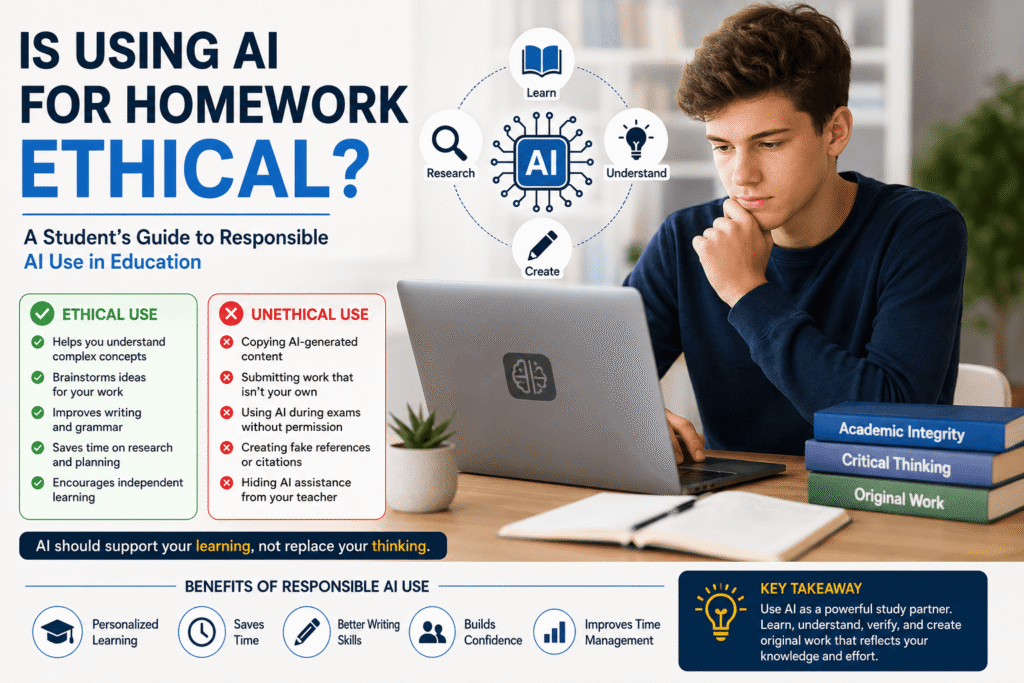
Infographic explaining AI ethics for students and responsible homework practices.

📦 Summary Box

Using AI for homework isn’t inherently ethical or unethical—it depends on how you use it.

Students who rely on AI to understand concepts, improve their work, and develop their own ideas are using technology responsibly. Those who use AI to replace independent thinking or submit generated work as their own risk undermining both academic integrity and long-term learning.

The most successful students treat AI as a knowledgeable study partner, not as a shortcut to avoid effort.

Conclusion

Artificial intelligence is reshaping education, and learning how to use it responsibly is becoming an essential skill. Understanding AI ethics for students helps you strike the right balance between embracing innovation and maintaining academic integrity.

The goal isn’t to avoid AI—it’s to use it wisely. When AI supports research, clarifies difficult concepts, improves writing, and encourages critical thinking, it can become a valuable learning companion. However, replacing your own effort with AI-generated work weakens the very skills education is designed to build.

As AI continues to evolve, students who combine curiosity, ethical decision-making, and independent thinking will be best prepared for future academic and professional success.

Leave a Comment

Your email address will not be published. Required fields are marked *