
Introduction
Students, professionals, and lifelong learners often struggle with the same challenge: there is too much information and not enough time. Whether you are preparing for exams, reviewing business materials, or learning a new skill, turning large amounts of information into clear notes can be exhausting.
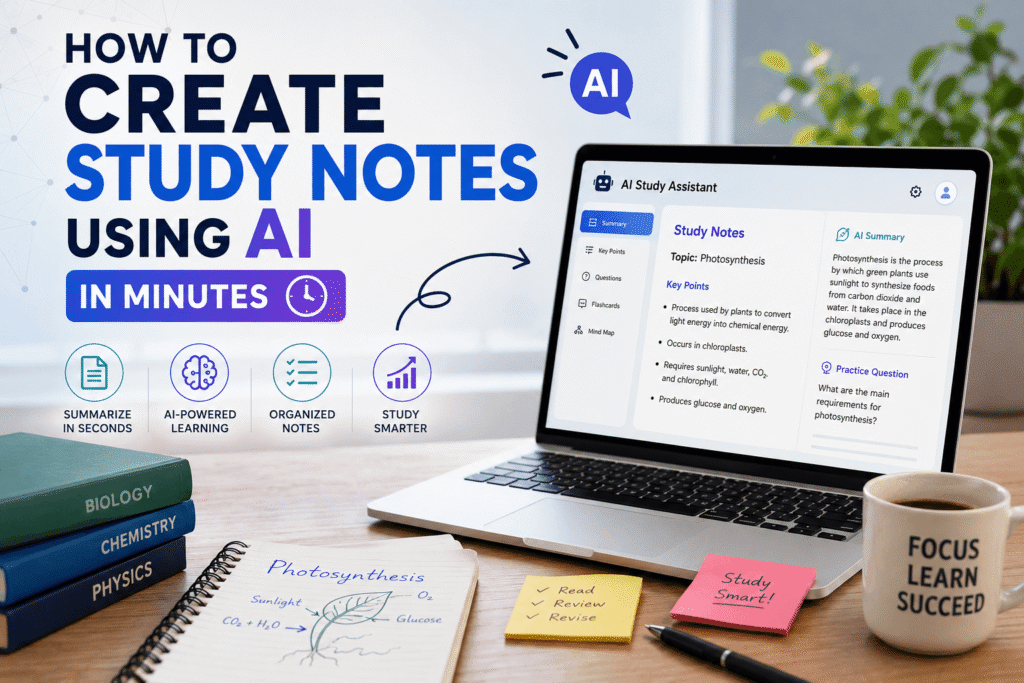
Learning how to create study notes using AI can completely change the way you organize information. Instead of spending hours rewriting textbooks, lecture slides, and research materials, AI-powered tools can help transform complex content into structured, easy-to-understand notes within minutes.
Modern AI study solutions allow learners to summarize information, highlight important concepts, create revision materials, and organize ideas more efficiently. When used correctly, AI does not replace learning—it supports better understanding and smarter study habits.
This guide explains how to use AI to create effective study notes, the benefits of AI-powered note creation, common mistakes to avoid, and practical strategies for students and professionals.
Table of Contents
- What Are AI Study Notes?
- Why Creating Study Notes Using AI Matters
- How AI Helps You Make Better Notes Faster
- Step-by-Step Guide to Create Study Notes Using AI
- Benefits of AI-Powered Study Notes
- Common Mistakes When Using AI for Notes
- Practical AI Study Notes Checklist
- How AI Study Tools Improve Learning
- Try AI-Powered Study Support
- Frequently Asked Questions
- Conclusion
What Are AI Study Notes?
AI study notes are digitally created learning materials generated or improved with artificial intelligence technology. These notes can be created from textbooks, articles, lecture recordings, PDFs, presentations, or online resources.
Instead of manually reading every page and writing everything down, AI tools analyze information and help organize it into useful formats.
Examples of AI-generated study materials include:
- Chapter summaries
- Key point lists
- Flashcards
- Question-and-answer sheets
- Revision guides
- Concept explanations
- Topic outlines
- Exam preparation notes
For example, a university student studying biology can upload lecture material and use AI to create a summary containing important definitions, processes, and exam-focused concepts.
A business professional can use similar tools to summarize industry reports, meeting notes, or training documents.
Why Creating Study Notes Using AI Matters
The Growing Need for Smarter Learning Methods
The amount of information people consume every day continues to increase. Students are managing online courses, digital textbooks, recorded lectures, and research materials. Employees are also expected to learn new technologies and processes faster than ever.
Traditional note-taking methods are valuable, but they can become time-consuming when dealing with large amounts of information.
AI helps solve this challenge by making the note creation process faster and more organized.
Instead of focusing on copying information, learners can spend more time understanding concepts, practicing skills, and applying knowledge.
AI Helps Reduce Information Overload
One of the biggest learning challenges today is information overload.
A single lecture or research document may contain hundreds of pages of information. Finding the most important points manually requires significant time and effort.
AI tools can help identify:
- Main ideas
- Important keywords
- Repeated concepts
- Definitions
- Relationships between topics
- Potential exam questions
This makes studying more focused and efficient.
How AI Helps You Make Better Notes Faster
1. AI Can Summarize Complex Information
One of the most useful features of AI study tools is automatic summarization.
Instead of reading a long document multiple times, AI can create a shorter version that highlights the essential information.
For example:
Original material:
A 50-page history chapter about the Industrial Revolution.
AI-generated notes:
- Causes of the Industrial Revolution
- Major inventions
- Economic changes
- Social impacts
- Important historical figures
This allows students to quickly review the core concepts before deeper study.
2. AI Organizes Information Automatically
Good notes are not just collections of information. They need structure.
AI can organize content into:
- Headings
- Bullet points
- Categories
- Timelines
- Comparison tables
- Study guides
This helps learners understand relationships between different ideas.
For example, instead of creating random notes about marketing strategies, AI can organize them into:
Digital Marketing
→ Search Engine Optimization
→ Social Media Marketing
→ Email Campaigns
→ Content Strategy
The result is easier to review and remember.
3. AI Creates Personalized Learning Materials
Everyone learns differently. Some people prefer summaries, while others learn better through questions, examples, or visual organization.
AI allows users to customize their study materials.
You can ask AI to create:
- Beginner-friendly explanations
- Advanced summaries
- Practice quizzes
- Flashcards
- Exam-style questions
- This personalized approach makes learning more effective.
Step-by-Step Guide: How to Create Study Notes Using AI
Step 1: Collect Your Learning Materials
Start by gathering the information you want to convert into notes.
This may include:
- Lecture slides
- PDF documents
- Articles
- Textbook chapters
- Research papers
- Class recordings
- Meeting documents
The better the source material, the better your AI-generated notes will be.
Step 2: Choose an AI Note-Taking Tool
Select an AI platform that matches your needs.
Look for features such as:
- Document summarization
- Note organization
- Question generation
- Export options
- Study planning features
- Multiple file support
Students may need exam-focused features, while professionals may prefer tools designed for reports and knowledge management.
Step 3: Upload or Enter Your Information
Add your learning material into the AI tool.
A useful prompt might be:
“Create detailed study notes from this chapter. Include key concepts, definitions, examples, and possible exam questions.”
Clear instructions help AI generate more relevant results.
Step 4: Review and Improve the Notes
AI-generated notes should always be reviewed.
Check:
- Accuracy of information
- Missing details
- Important examples
- Course requirements
- Teacher instructions
AI is a powerful assistant, but human review ensures quality.
Benefits of Creating Study Notes Using AI
Using AI for note creation provides advantages beyond saving time. It can improve organization, support better understanding, and help learners develop more effective study routines.
1. Saves Valuable Time
One of the biggest advantages of AI-generated study notes is speed.
Traditional note-taking often requires hours of reading, highlighting, rewriting, and organizing information. AI can complete the first stage of this process within minutes.
This extra time can be used for:
- Practicing questions
- Reviewing difficult topics
- Completing assignments
- Preparing for exams
- Developing deeper understanding
For students in the USA, Canada, Europe, and the UK, where academic workloads are often demanding, AI can become a valuable productivity partner.
2. Improves Study Organization
Disorganized notes can make studying more difficult. Important information may become difficult to find, especially before exams.
AI helps create structured notes with:
- Clear headings
- Important keywords
- Summarized explanations
- Logical topic flow
- Revision-friendly formatting
Well-organized notes reduce stress and make revision faster.
3. Supports Active Learning
Effective learning is not just about reading information repeatedly. Active learning techniques such as testing yourself, explaining concepts, and solving problems improve memory.
AI can help create active learning materials, including:
- Practice quizzes
- Flashcards
- Discussion questions
- Self-assessment exercises
For example, instead of simply creating notes about chemistry, AI can generate questions like:
“What happens during a chemical reaction?”
“What are the key differences between acids and bases?”
This encourages deeper understanding.
4. Helps Different Types of Learners
Every learner has a different study style.
Some people prefer:
- Short summaries
- Detailed explanations
- Visual organization
- Examples
- Practice questions
- AI study tools can adapt information into different formats, making learning more accessible.
Common Mistakes to Avoid When Using AI for Study Notes
Although AI is powerful, using it incorrectly can reduce the quality of your learning.
1. Depending Completely on AI
AI should support learning, not replace it.
Simply generating notes and memorizing them without understanding the topic can create gaps in knowledge.
The best approach is:
- Use AI to organize information.
- Review the generated notes.
- Add your own thoughts and examples.
- Test your understanding.
2. Using Poor Prompts
The quality of AI-generated notes depends heavily on the instructions you provide.
A vague prompt such as:
“Make notes.”
may create basic results.
A better prompt would be:
“Create detailed university-level study notes from this material. Include definitions, important concepts, examples, and possible exam questions.”
Clear prompts produce better outcomes.
3. Not Checking Accuracy
AI tools can occasionally produce incorrect or incomplete information.
Always verify:
- Facts
- Statistics
- Scientific explanations
- Dates
- Technical information
For academic work, use trusted sources alongside AI assistance.
4. Creating Notes Without Personal Review
Personal involvement improves memory.
After AI creates your notes, consider adding:
- Your own examples
- Questions you still have
- Important class comments
- Additional explanations
Personalized notes are usually more valuable than automatically generated content.
Practical Checklist for Creating AI Study Notes
Before using your AI-generated notes, review this checklist:
 Upload reliable learning materials Use clear AI instructions and prompts Ask for summaries, explanations, and questions Organize notes into logical sections Review AI-generated information Add personal examples and comments Create revision materials such as flashcards Test your understanding regularly Update notes as you learn more
Following these steps helps you create study notes using AI that are accurate, useful, and designed for long-term learning.
How AI Study Tools Improve Learning Productivity
AI is changing the way students and professionals manage information.
Previously, learners spent most of their time collecting information. Today, AI allows them to spend more time analyzing, practicing, and applying knowledge.
AI as a Personal Learning Assistant
An AI learning assistant can help with many parts of the learning process:
- Explaining difficult concepts
- Summarizing resources
- Creating revision plans
- Generating practice questions
- Improving note organization
For example, a medical student preparing for exams can use AI to summarize complex topics into revision sheets. A marketing professional can use AI to turn industry reports into actionable insights.
Try a Smarter Way to Study With AI
Creating effective notes should not take hours of manual work. With AI-powered study solutions, learners can organize information faster, understand difficult topics more easily, and create personalized revision materials.
Whether you are a student preparing for exams, a professional learning new skills, or an organization supporting digital education, AI can help simplify the learning process.
Ready to improve your study workflow?
Explore smarter AI learning solutions today and discover how easy it can be to create organized, high-quality study notes in minutes.
Frequently Asked Questions (FAQ)
Can I create study notes using AI in minutes?
Yes. AI tools can quickly summarize textbooks, articles, PDFs, and lecture materials into organized study notes. The final quality depends on the source material and the instructions provided.
Are AI-generated study notes accurate?
AI-generated notes can be highly useful, but they should always be reviewed. Students should verify important information using textbooks, teachers’ materials, and trusted sources.
What types of study materials can AI summarize?
AI can help summarize many types of materials, including:
Textbooks
Research papers
Lecture slides
PDFs
Articles
Meeting documents
Training materials
Can AI create exam preparation notes?
Yes. Many AI tools can create exam-focused materials such as summaries, flashcards, practice questions, and revision guides.
Is using AI for study notes better than traditional note-taking?
AI does not replace traditional learning methods. Instead, it improves the note-taking process by saving time, organizing information, and helping learners focus on understanding concepts.
Conclusion
Learning how to create study notes using AI can transform the way students and professionals manage information. Instead of spending hours manually rewriting content, AI allows users to quickly organize ideas, summarize important concepts, and create personalized learning materials.
The most effective approach is combining AI technology with human thinking. Use AI to save time, improve organization, and support learning—but always review, personalize, and engage with the material.
As education continues to become more digital, AI-powered study tools will play an increasingly important role in helping people learn faster and more efficiently.
Whether you are preparing for an exam, developing professional skills, or managing large amounts of information, creating smarter AI-assisted notes can help you achieve better learning outcomes.
Pingback: Best AI Tools for Writing Academic Essays (2026 Guide)
Pingback: Machine Learning vs AI vs Deep Learning Explained
Pingback: AI Ethics for Students: Is AI Homework Ethical?