
Introduction
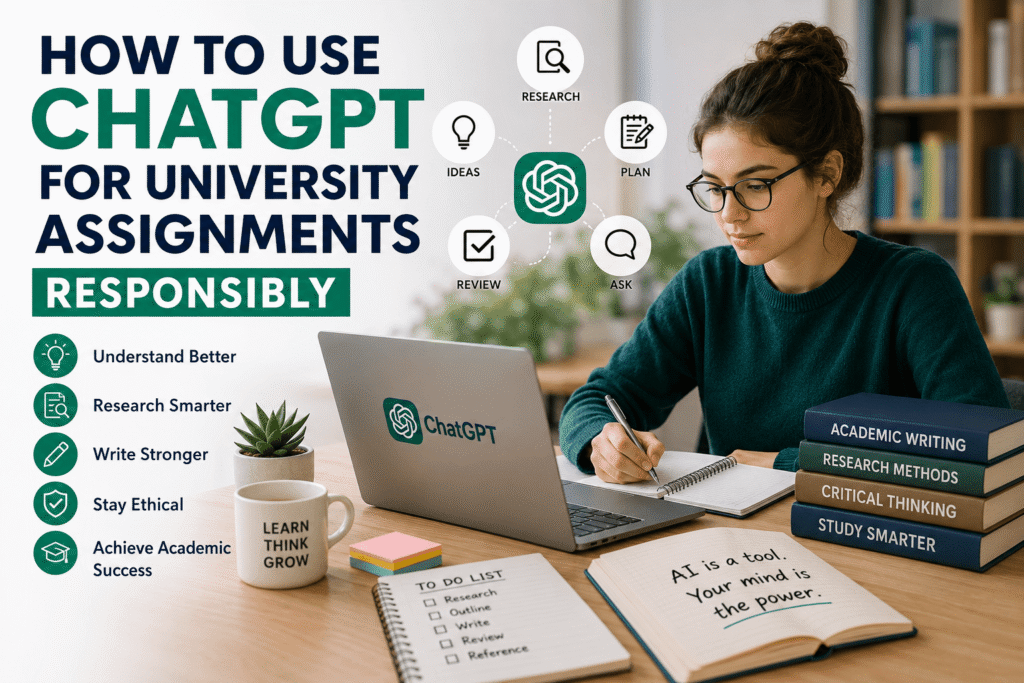
Using ChatGPT for university assignments responsibly has become an essential skill for today’s students. Artificial intelligence is changing the way learners research, organize ideas, improve writing, and prepare for exams. While AI tools offer significant advantages, they also introduce important questions about academic integrity, originality, and ethical learning.
Universities across the USA, Canada, the UK, and Europe are increasingly developing policies that allow AI-assisted learning while discouraging misuse. Rather than replacing independent thinking, ChatGPT should support your learning process by helping you understand complex topics, brainstorm ideas, and improve communication skills.
When used responsibly, ChatGPT can become a valuable academic assistant that saves time, reduces stress, and enhances productivity without compromising your education.
Table of Contents
- Why Responsible AI Use Matters in Higher Education
- What ChatGPT Can and Cannot Do
- Benefits of Using ChatGPT Responsibly
- Step-by-Step Guide to Responsible ChatGPT Use
- Best Practices for Ethical AI-Assisted Learning
- Common Mistakes to Avoid
- Practical Student Checklist
- Internal & External Learning Resources
- Frequently Asked Questions
- Conclusion
Why Responsible AI Use Matters in Higher Education
Artificial intelligence is rapidly becoming part of everyday university life. Students use AI tools to summarize research papers, explain difficult concepts, generate study questions, and improve grammar. However, universities are also strengthening academic integrity policies to ensure students continue developing critical thinking and independent problem-solving skills.
Responsible AI use benefits everyone involved in education.
It Supports Genuine Learning
Learning is more than completing assignments. University education develops analytical thinking, creativity, communication, and research skills. ChatGPT should enhance these abilities—not replace them.
Instead of asking AI to complete an essay, students can use it to:
- Understand unfamiliar concepts
- Break complex topics into manageable sections
- Generate revision questions
- Improve writing clarity
- Practice academic discussions
It Protects Academic Integrity
Submitting AI-generated work as your own may violate your institution’s academic policies. Responsible use means treating ChatGPT as a learning companion rather than an assignment-writing service.
Always review your university’s guidelines regarding AI-assisted work before submitting assignments.
What ChatGPT Can and Cannot Do
Understanding ChatGPT’s strengths and limitations helps students use it effectively.
What ChatGPT Does Well
ChatGPT excels at supporting learning activities such as:
- Explaining difficult theories
- Simplifying academic language
- Brainstorming essay ideas
- Creating study plans
- Generating practice quizzes
- Improving grammar and readability
- Suggesting research directions
- Helping organize reports
For example, if you’re studying economics, you can ask ChatGPT to explain inflation using simple language before exploring scholarly sources.
Similarly, engineering students can request step-by-step explanations of mathematical concepts without asking AI to solve graded coursework.
What ChatGPT Should Not Replace
There are important tasks that require your own effort and judgment.
Avoid using ChatGPT to:
- Write complete assignments for submission
- Fabricate references
- Invent research findings
- Create fake citations
- Complete examinations
- Produce work that violates university policies
Remember that AI can occasionally generate inaccurate or outdated information. Always verify facts using credible academic sources.
Benefits of Using ChatGPT Responsibly
Students who use ChatGPT for University Assignments ethically often experience improvements in both learning efficiency and academic confidence.
Better Understanding of Difficult Topics
Instead of spending hours searching through multiple resources, students can receive simple explanations tailored to their current level of understanding.
For instance, ChatGPT can explain statistical concepts, programming syntax, or historical events using everyday language before you move on to academic textbooks.
Improved Writing Skills
Many students struggle with sentence structure, grammar, and clarity.
ChatGPT can help:
- Improve paragraph flow
- Suggest stronger vocabulary
- Correct grammatical errors
- Enhance readability
Make academic writing more concise
The final writing should always reflect your own understanding and voice.
Increased Productivity
University life involves balancing lectures, assignments, projects, exams, and part-time work.
Using ChatGPT responsibly can help students:
- Create study schedules
- Organize research notes
- Draft presentation outlines
- Summarize lengthy articles
- Generate revision questions
This allows students to spend more time learning rather than organizing information.
Enhanced Critical Thinking
One overlooked advantage of AI is its ability to encourage deeper thinking.
Ask ChatGPT questions such as:
- “Can you explain both sides of this argument?”
- “What evidence supports this theory?”
- “How would a critic respond?”
- “What assumptions are being made?”
These prompts encourage analysis rather than simple answer generation.
Step-by-Step Guide to Using ChatGPT Responsibly for University Assignments
Following a structured approach helps ensure AI remains a learning tool instead of a shortcut.
Step 1 – Understand the Assignment Yourself
Before opening ChatGPT for University Assignments, carefully read the assignment brief.
Ask yourself:
- What is the objective?
- What learning outcomes are expected?
- What type of evidence is required?
- Are AI tools permitted?
Understanding the assignment first prevents overreliance on AI and ensures your work aligns with university expectations.
Step 2 – Use ChatGPT for Brainstorming
Rather than requesting a finished essay, ask for assistance generating ideas.
Examples include:
- Possible research questions
- Essay structures
- Counterarguments
- Topic outlines
- Discussion points
This helps overcome writer’s block while keeping your work original.
Step 3 – Verify Every Fact
Although ChatGPT is highly capable, it can occasionally produce incorrect or outdated information.
Always confirm:
- Statistics
- Dates
- Definitions
- Research findings
- Citations
- Quotes
Use trusted academic databases, library resources, textbooks, and peer-reviewed journals to verify important information before including it in your assignment.
Best Practices for Ethical AI-Assisted Learning
Using ChatGPT effectively isn’t about finding shortcuts—it’s about improving how you learn. By following a few simple practices, you can benefit from AI while maintaining academic integrity and developing valuable skills.
Make AI Part of Your Learning Process
Think of ChatGPT as a study partner rather than a replacement for your own work. Use it to clarify difficult concepts, organize ideas, or review your understanding after you’ve completed your own research.
For example, after reading several journal articles, you could ask ChatGPT to explain the key themes in simpler language. This reinforces your understanding without replacing the research process.
Use Reliable Sources Alongside AI
AI-generated responses should never be your only source of information. Support your assignments with peer-reviewed journals, academic books, university library databases, and reputable websites.
Write in Your Own Voice
One of the easiest ways to use ChatGPT responsibly is to treat its responses as a starting point. Rewrite ideas in your own words, add your own analysis, and include examples that reflect your understanding.
This approach creates more authentic work and helps you retain what you’ve learned.
Be Aware of Your University's AI Policy
Every institution has its own expectations regarding AI-assisted learning. Some allow limited use, while others require students to disclose when AI tools have been used.
Before submitting any assignment, review your course guidelines and ask your instructor if you’re unsure.
Common Mistakes to Avoid
Students often misuse AI without intending to. Avoiding these common mistakes can help you stay on the right track.
- Copying AI-generated text directly into an assignment.
- Trusting every response without checking the facts.
- Using fabricated references or citations.
- Depending on AI instead of reading the required course materials.
- Ignoring university policies on AI use.
- Asking ChatGPT to complete graded assessments or exams.
- Forgetting to add your own analysis and critical thinking.
Responsible use means combining AI assistance with independent learning—not replacing it.
Practical Checklist for Responsible ChatGPT Use
Before submitting your assignment, ask yourself:
- Have I completed my own research?
- Did I verify important facts and statistics?
- Are all references accurate and properly cited?
- Does the assignment reflect my own understanding?
- Have I followed my university’s AI policy?
- Did I proofread the final version myself?
- Can I confidently explain everything I’ve written?
If you answered “yes” to each question, you’re likely using ChatGPT in a responsible and academically sound way.
Suggested Learning Resources
Continue improving your academic skills by exploring related resources.These articles can help you build effective study habits while making the most of modern AI tools.These resources provide reliable guidance on academic writing, responsible AI use, and research best practices.
Make AI Work for You—Not Instead of You
AI is becoming a permanent part of education, and students who learn to use it responsibly will be better prepared for both university and the workplace.
If you’re looking for practical guides, prompt libraries, and honest advice on using AI for studying, explore the latest resources on My AI Study Zone. Whether you’re learning how to research more efficiently, improve your writing, or use AI ethically, you’ll find actionable tips designed for today’s students.
Frequently Asked Questions
Is it acceptable to use ChatGPT for university assignments?
In many cases, yes. However, it depends on your university’s policies and the specific requirements of your course. Always review the guidance provided by your institution before using AI in assessed work.
Can ChatGPT help without causing plagiarism?
Yes. ChatGPT can support brainstorming, planning, and editing, but your final submission should reflect your own understanding and writing. Always cite sources correctly and avoid copying AI-generated text verbatim.
Should I verify information generated by ChatGPT?
Absolutely. AI can occasionally provide inaccurate or outdated information. Confirm important facts using credible academic sources before including them in your assignment.
What are the best ways to use ChatGPT while studying?
Students often use ChatGPT to explain difficult concepts, create revision questions, summarize notes, develop essay outlines, and improve grammar. These uses support learning without replacing independent thinking.
Will universities know if I use ChatGPT?
Many universities focus less on detecting AI use and more on whether students follow academic integrity policies. If your institution requires disclosure of AI assistance, be transparent and ensure your work demonstrates your own knowledge and critical thinking.
Conclusion
Learning how to use ChatGPT for university assignments responsibly is about finding the right balance between innovation and academic integrity. Used thoughtfully, AI can help you understand complex topics, organize ideas, improve your writing, and study more efficiently.
The most successful students don’t rely on AI to do the work for them. They use it to ask better questions, deepen their understanding, and strengthen the skills that matter most in higher education.
As AI continues to shape education, responsible use will remain an important part of academic success. By combining ChatGPT with critical thinking, independent research, and credible sources, you’ll produce stronger assignments while building knowledge that lasts beyond graduation.
Pingback: 15 Free AI Tools Every Student Should Know in 2026
Pingback: Best ChatGPT Prompts for Exam Preparation
Pingback: AI and Creativity: Can AI Replace Human Imagination?