
Introduction
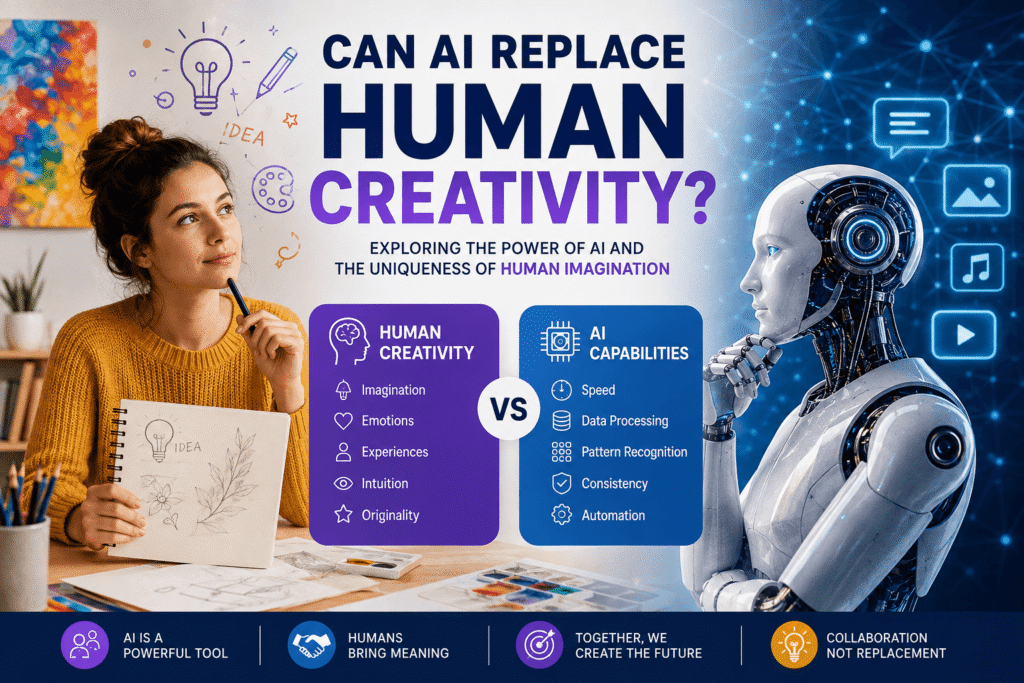
Have you ever wondered whether a computer could write a bestselling novel, compose a chart-topping song, or paint a masterpiece that rivals the work of history’s greatest artists?
Artificial intelligence has made remarkable progress in recent years. AI tools can generate artwork, write articles, compose music, design logos, and even create videos within minutes. This rapid advancement has sparked an important debate about AI and creativity. Is AI becoming truly creative, or is it simply producing impressive results based on patterns it has learned?
For artists, writers, marketers, business owners, educators, and students, this question is more than just an interesting discussion. It affects careers, business strategies, education, and the future of creative work itself. Many people worry that AI could replace human talent, while others believe it will become one of the most valuable creative partners ever developed.
In this guide, you’ll discover what creativity really means, how AI generates creative content, where it excels, where it still falls short, and why the future is likely to involve collaboration rather than competition. You’ll also learn practical ways to use AI responsibly while preserving the uniquely human qualities that make creative work meaningful.
📌 Key Takeaways
- AI can generate creative-looking content but does not experience imagination or emotions.
- Human creativity is driven by lived experiences, intuition, empathy, and purpose.
- The strongest results often come from combining AI tools with human expertise.
- Understanding AI and creativity helps individuals and businesses use technology more effectively.
Table of Contents
- Introduction
- Why AI and Creativity Matter Today
- What Is Creativity?
- How AI Creates Content
- Can AI Truly Be Creative?
- Benefits of AI in Creative Work
- Best Practices for Using AI
- Common Mistakes to Avoid
- Practical Checklist
- Resources & Links
- FAQ
- Conclusion
Why AI and Creativity Matter Today
Artificial intelligence is transforming nearly every creative industry. Graphic designers now use AI to brainstorm concepts, writers use it to overcome writer’s block, musicians experiment with AI-generated melodies, and filmmakers rely on AI-powered editing tools to speed up production.
This shift is changing how creative work is produced and delivered.
Businesses benefit from faster content creation, lower production costs, and improved efficiency. At the same time, professionals must learn how to combine technology with human expertise to remain competitive.
The growing influence of AI also raises important questions.
- Will creative jobs disappear?
- Can AI understand emotions?
- Is AI-generated art authentic?
- Who owns AI-created content?
- How can people use AI responsibly?
Understanding these questions helps individuals make informed decisions rather than reacting out of fear or unrealistic expectations.
Real-World Example
A marketing agency creating hundreds of social media posts every month may use AI to generate initial captions and campaign ideas. However, experienced marketers still refine the messaging, adapt it to the brand’s voice, verify facts, and ensure it connects with the intended audience.
AI speeds up the process, but human judgment delivers the final quality.
What Does Creativity Really Mean?
Creativity is more than producing something new.
It involves solving problems, expressing emotions, connecting ideas in unexpected ways, and creating something meaningful that resonates with people.
Psychologists generally describe creativity as the ability to produce work that is both original and valuable.
Human creativity develops through:
- Personal experiences
- Emotions
- Culture
- Curiosity
- Imagination
- Critical thinking
- Collaboration
- Mistakes and learning
Every person’s creative journey is unique because no two people share exactly the same life experiences.
That uniqueness shapes the stories we tell, the art we create, and the solutions we develop.
Human Creativity vs Artificial Intelligence
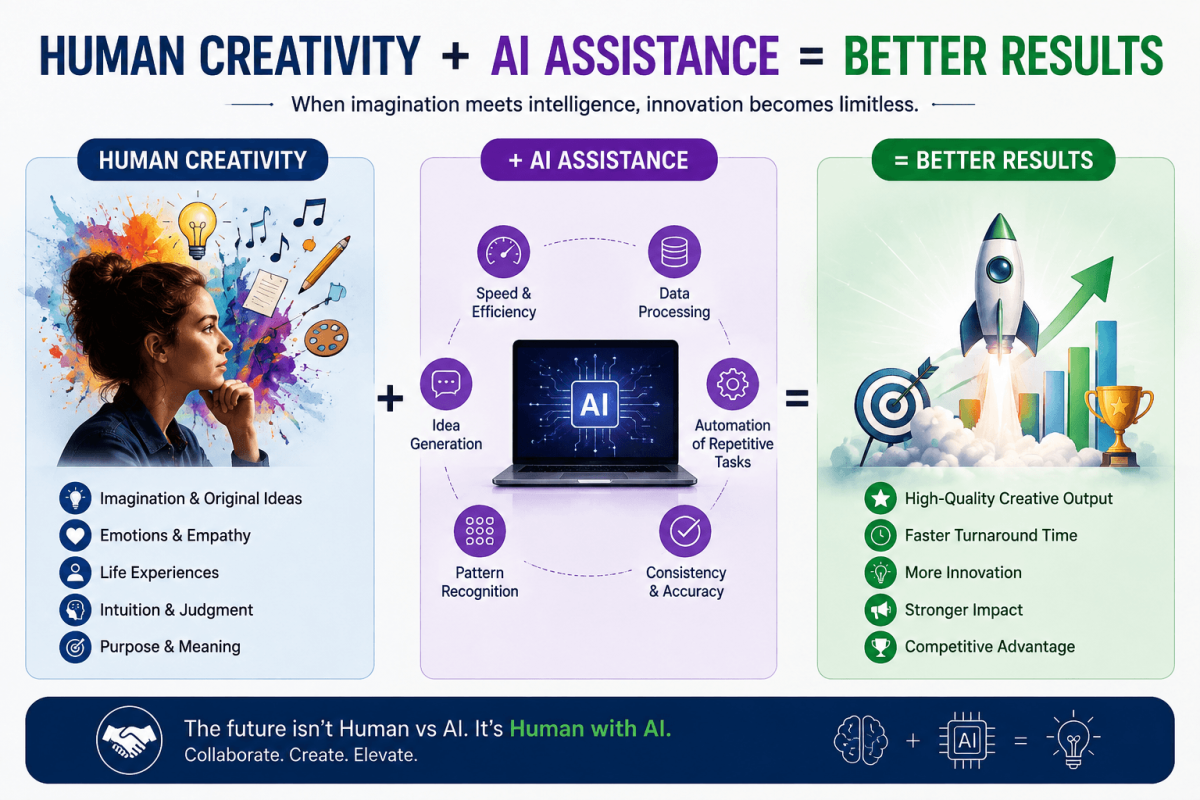
Humans create because they feel inspired, curious, passionate, or challenged.
AI creates because algorithms predict the most likely output based on patterns in data.
This distinction is crucial.
Although AI can imitate many creative styles, it does not possess self-awareness, personal experiences, or emotional understanding.
What is creativity?
Creativity is the ability to produce original and valuable ideas by combining imagination, knowledge, emotions, and problem-solving skills. While AI can generate content based on learned patterns, human creativity is shaped by personal experiences, emotions, and intentional thinking.
How Artificial Intelligence Creates Creative Content
Modern AI systems rely on machine learning and large datasets rather than imagination.
Instead of inventing ideas from personal experiences, AI analyzes millions or even billions of examples to identify patterns and generate new outputs that resemble what it has learned.
For example:
- AI writing tools predict the next word in a sentence.
- AI image generators transform text prompts into artwork.
- AI music generators compose melodies based on existing musical structures.
- AI video tools create animations and edit footage automatically.
Although these outputs can appear highly creative, they are generated through statistical prediction rather than conscious inspiration.
Example
A designer asks an AI image generator:
“Create a futuristic city at sunset with flying vehicles and sustainable architecture.”
The AI doesn’t imagine the city.
Instead, it combines visual patterns learned from countless images containing cities, sunsets, architecture, lighting, and futuristic concepts.
The final image may look original, but it is built from learned relationships rather than lived experience.
Expert Tip
Treat AI as a creative assistant rather than a replacement. Use it to generate ideas, draft concepts, or automate repetitive tasks, then add your own expertise, emotion, and critical thinking to produce work that feels authentic.
Can AI Replace Human Creativity?
No, AI cannot fully replace human creativity. While AI can generate text, images, music, videos, and designs by recognizing patterns in data, it lacks consciousness, emotions, personal experiences, and intentional thinking. The best creative outcomes usually come from combining AI’s speed with human imagination, critical thinking, and emotional intelligence.
Where AI Excels
Artificial intelligence has become an exceptional assistant for repetitive and time-consuming creative tasks. It can process vast amounts of information within seconds and generate multiple ideas much faster than humans.
AI performs particularly well in areas such as:
- Brainstorming content ideas
- Writing first drafts
- Generating marketing copy
- Designing logo concepts
- Creating illustrations
- Editing photos and videos
- Translating content
- Summarising long documents
Personalising customer experiences
Automating repetitive design work
For businesses, this means faster workflows, lower production costs, and increased productivity.
Where Humans Still Lead
Despite its impressive capabilities, AI cannot truly understand what it creates.
Humans continue to outperform AI in areas that require:
- Emotional storytelling
- Empathy
- Cultural understanding
- Ethical decision-making
- Original innovation
- Personal experiences
- Leadership
- Strategic thinking
- Long-term vision
A novel that deeply moves readers, a painting inspired by grief, or a speech that changes lives comes from human experiences—not algorithms.
This emotional depth is one of the biggest reasons why AI and creativity should be viewed as complementary rather than competitive.
Comparison Table: Human Creativity vs AI Creativity
Feature Human Creativity AI Creativity
Personal experiences
Emotions
Pattern recognition Limited Excellent
Speed Moderate Extremely Fast
Original inspiration Limited
Consistency Varies Very High
Ethical judgment Limited
Learning from life
Works 24/7
Requires prompts
Summary Box: AI is excellent at generating possibilities, while humans excel at creating meaning.
Benefits of Combining AI and Creativity
Instead of asking whether AI will replace creativity, a better question is:
How can humans and AI work together?
Many successful professionals already use AI as a creative partner.
Faster Brainstorming
Creative blocks happen to everyone.
AI can instantly generate:
- Blog ideas
- Marketing campaigns
- Video scripts
- Product names
- Headlines
- Business slogans
Rather than replacing creativity, AI often sparks new ideas that humans can improve.
Higher Productivity
Creative professionals spend significant time on repetitive tasks.
AI helps automate:
- Research summaries
- Grammar corrections
- Background removal
- Image resizing
- Caption generation
- Data organization
This allows creators to spend more time on strategic and artistic work.
Better Collaboration
Modern teams frequently combine human expertise with AI-generated suggestions.
For example:
A graphic designer may ask AI to generate five logo concepts.
Instead of using them directly, the designer combines the strongest elements into an original design that aligns with the client’s vision.
AI accelerates ideation.
Humans make the final creative decisions.
Improved Accessibility
People with limited artistic experience can now create:
- Presentations
- Videos
- Digital artwork
- Marketing materials
- Websites
- Music
AI lowers technical barriers and enables more people to express their ideas creatively.
📦 Key Takeaways Box
Benefits of AI in Creative Work
✔ Speeds up idea generation
✔ Reduces repetitive work
✔ Improves productivity
✔ Supports collaboration
✔ Makes creative tools more accessible
✔ Helps beginners learn faster
✔ Enables rapid experimentation
Real-World Case Studies of AI and Creativity
Case Study 1: Marketing Agency
A digital marketing agency in Canada uses AI to generate initial advertising copy for clients.
Instead of writing from scratch, the marketing team reviews the AI-generated content, adjusts the tone, verifies accuracy, and incorporates the client’s brand voice.
Result:
Faster campaign creation
Better consistency
More time for strategy
Higher client satisfaction
Case Study 2: Independent Artist
A digital artist in Germany uses AI image generators to explore concept art before creating the final illustrations manually.
The AI provides inspiration, but the final artwork reflects the artist’s personal style and storytelling.
Lesson:
AI becomes a creative assistant rather than a replacement.
Case Study 3: Software Development Team
A software company in the UK uses AI coding assistants to generate boilerplate code and documentation.
Senior developers still review, optimize, and secure the code before deployment.
Outcome:
Development becomes faster without compromising software quality.
Best Practices for Using AI Creatively
To get the most value from AI, use it strategically rather than relying on it completely.
Step 1: Start with Your Own Ideas
Think independently before asking AI for suggestions.
This ensures your work remains authentic and original.
Step 2: Use Detailed Prompts
Specific prompts produce better results.
Instead of writing:
“Write a blog.”
Try:
“Write a beginner-friendly blog explaining AI and creativity for small business owners in the UK using simple language.”
Step 3: Verify Facts
AI can occasionally generate inaccurate or outdated information.
Always verify:
- Statistics
- Research
- Quotes
- References
- Technical explanations
Step 4: Add Human Perspective
Include:
- Personal experiences
- Customer stories
- Industry knowledge
- Original examples
- Professional opinions
These elements create trust and authenticity.
Step 5: Edit Before Publishing
Never publish AI-generated content without reviewing it carefully.
Check for:
- Grammar
- Accuracy
- Brand voice
- SEO optimization
- Readability
- Originality
Expert Tip
Use AI for the first 60–70% of repetitive work, then spend the remaining time refining, fact-checking, and adding your unique insights. This balance helps maintain quality while significantly improving productivity.
Common Mistakes to Avoid
Many people expect AI to produce perfect results immediately.
That expectation often leads to poor-quality content.
Avoid these common mistakes:
Copying AI output without editing
Publishing inaccurate information
Ignoring copyright considerations
Using vague prompts
Overusing AI-generated wording
Removing the human voice
Forgetting to verify sources
Assuming AI understands emotions
Neglecting ethical considerations
Summary Box
Remember:
AI generates content.
Humans create meaning.
That distinction is what makes successful creators stand out.
Practical Checklist for Using AI Responsibly
Before publishing any AI-assisted content, ask yourself:
□ Does this content reflect my own ideas?
□ Have I verified all facts?
□ Is the writing easy to understand?
□ Have I added personal insights?
□ Does the content match my brand voice?
□ Is the work original and valuable?
□ Have I checked grammar and readability?
□ Is the SEO optimized naturally?
□ Have I cited reliable sources where needed?
□ Would I confidently put my name on this content?
If you answered “Yes” to every question, your content is much more likely to provide genuine value to readers.
Ready to Learn More About Artificial Intelligence?
Artificial intelligence is changing how we work, learn, and create. Staying informed today will help you make smarter decisions tomorrow.
Whether you’re a student, business owner, marketer, or simply curious about AI, My AI Study Zone provides beginner-friendly guides, practical tutorials, and expert insights to help you understand this fast-moving technology.
Explore more AI guides, discover practical use cases, and learn how to use AI responsibly to improve your skills and productivity.
Start exploring today and stay ahead in the AI-powered future.
Frequently Asked Questions (FAQ)
What is AI and creativity?
AI and creativity refer to the relationship between artificial intelligence and the creative process. AI can generate content, ideas, images, music, and designs, while human creativity adds originality, emotion, critical thinking, and personal experiences.
Can AI completely replace human creativity?
No. AI can assist with creative tasks and automate repetitive work, but it cannot fully replace human imagination, emotions, intuition, or lived experiences. The most successful creative work combines AI assistance with human expertise.
Is AI-generated content considered original?
AI-generated content can produce unique combinations of information, but it is created using patterns learned from existing data. Human editing, expertise, and originality are essential for creating valuable and authentic work.
Which industries benefit most from AI and creativity?
Many industries benefit from AI-assisted creativity, including:
- Marketing
- Graphic design
- Software development
- Film production
- Advertising
- Education
- Architecture
- Product design
- Content creation
- AI helps professionals work faster while allowing humans to focus on strategy and innovation.
How can I use AI responsibly in creative work?
Use AI as a tool to brainstorm ideas, automate repetitive tasks, and improve productivity. Always verify facts, edit AI-generated content, respect copyright laws, and add your own expertise, creativity, and personal perspective.
Conclusion
Artificial intelligence has transformed the creative landscape, making it easier than ever to generate ideas, produce content, and automate repetitive tasks. However, despite these remarkable advances, AI still lacks the qualities that define genuine human creativity—emotion, curiosity, empathy, intuition, and lived experience.
The future of AI and creativity is unlikely to be a story of replacement. Instead, it is a story of collaboration.
Writers can use AI to overcome writer’s block. Designers can explore concepts more quickly. Musicians can experiment with new sounds. Businesses can produce content more efficiently. Yet in every successful example, people remain at the center of the creative process.
As AI continues to evolve, those who learn to combine technological efficiency with human imagination will be best positioned to succeed. Rather than fearing AI, embrace it as a powerful creative partner that helps you work smarter while preserving the originality and purpose that only humans can provide.
The future belongs not to AI alone—but to people who know how to use it creatively and responsibly.
References
For credibility and further reading, consider referencing the following authoritative resources:
- OpenAI Research
- Stanford Institute for Human-Centered Artificial Intelligence (HAI)
- MIT Technology Review – Artificial Intelligence
- UNESCO Recommendation on the Ethics of Artificial Intelligence
- World Economic Forum – Artificial Intelligence
- OECD AI Principles
- European Commission AI Act documentation
Author Bio
About the Author
My AI Study Zone Editorial Team
The My AI Study Zone team publishes beginner-friendly articles that explain artificial intelligence in clear and practical language. Our mission is to help students, professionals, educators, and businesses understand AI technologies, explore responsible AI practices, and stay informed about the latest developments in artificial intelligence.

