
Introduction
Generative AI is one of the most transformative technologies of the modern digital era. From creating written content and realistic images to generating code and assisting with business decisions, Generative AI is changing how people work, learn, and innovate.
Whether you are a business owner, marketer, student, or technology enthusiast, understanding Generative AI can help you stay competitive in an increasingly AI-driven world. In this guide, we’ll explain what Generative AI is, how it works, its benefits, practical applications, and best practices for using it effectively.
Artificial Intelligence has evolved rapidly over the last decade, but few innovations have captured global attention like Generative AI. Unlike traditional AI systems that analyze data and make predictions, Generative AI creates entirely new content.
It can write articles, generate images, create videos, compose music, build software code, and even assist with complex business workflows. This capability has opened new opportunities for organizations across the USA, Canada, Europe, and the UK.
As AI technology continues to advance, understanding Generative AI is becoming an essential skill for professionals and businesses alike.
Table of Contents
- Introduction
- Why Generative AI Matters
- What Is Generative AI?
- How Generative AI Works
- Key Benefits of Generative AI
- Real-World Applications
- Best Practices for Using Generative AI
- Common Mistakes to Avoid
- Practical Generative AI Checklist
- Internal and External Link Suggestions
- Call to Action
- FAQs
- Conclusion
Why Generative AI Matters in Today's Digital Economy
Generative AI is no longer a futuristic concept. It is actively shaping industries, improving productivity, and creating new business opportunities.
Increased Productivity
Organizations use AI-powered tools to automate repetitive tasks, allowing employees to focus on strategic work.
Faster Content Creation
Marketing teams can generate blog posts, social media content, product descriptions, and email campaigns much faster than traditional methods.
Enhanced Customer Experiences
Businesses use AI chatbots and virtual assistants to provide personalized support and improve customer satisfaction.
Innovation at Scale
Generative AI helps companies experiment with ideas, develop prototypes, and solve problems more efficiently.
What Is Generative AI?
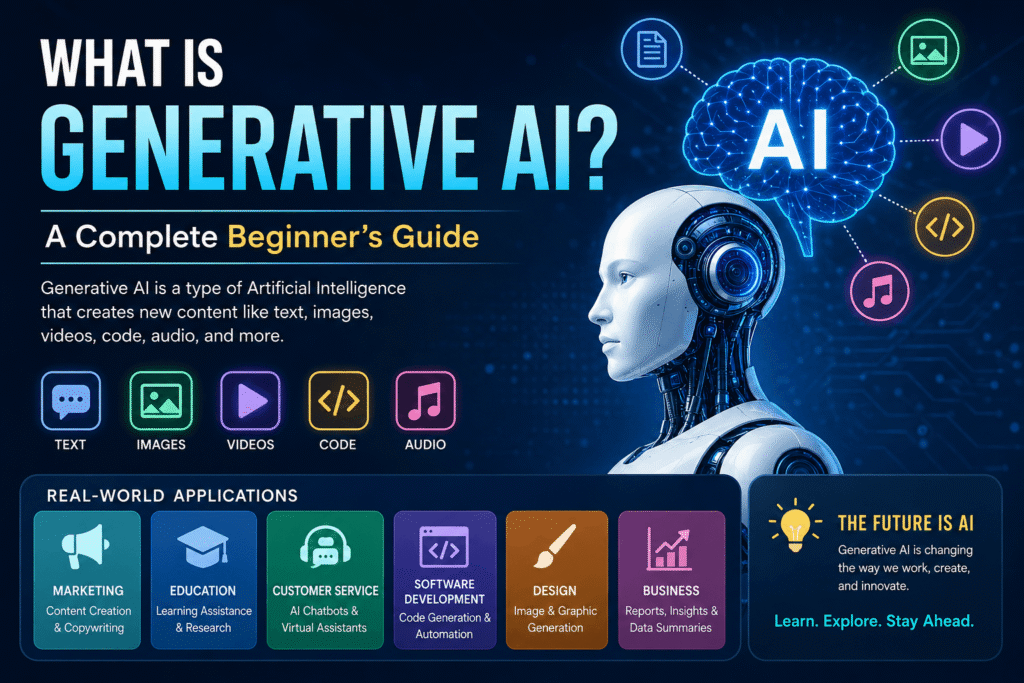
Generative AI refers to a category of Artificial Intelligence designed to create new content based on patterns learned from large datasets.
Instead of simply analyzing information, it generates original outputs such as:
- Text
- Images
- Videos
- Audio
- Computer code
- Designs
- Business reports
For example, when you ask an AI tool to write an article, create an image, or generate software code, it uses learned patterns to produce a new result that resembles human-created content.
Popular examples include:
- ChatGPT
- Gemini
- Claude
- Midjourney
- DALL·E
- GitHub Copilot
These tools demonstrate how Generative AI can support creativity, productivity, and decision-making.
How Generative AI Works
Understanding the basics of how Generative AI works helps users make better use of the technology.
Training on Large Datasets
AI models learn from massive amounts of text, images, videos, and other data sources.
The system identifies patterns, relationships, and structures within the information.
Machine Learning and Neural Networks
Generative AI relies on advanced machine learning techniques and neural networks that mimic certain aspects of human learning.
Many modern systems use Large Language Models (LLMs) that can understand and generate human-like text.
Prompt-Based Generation
Users provide instructions known as prompts.
For example:
“Write a 500-word blog post about renewable energy.”
The AI interprets the request and generates a response based on its training data.
Continuous Improvement
AI models improve through ongoing training, updates, and feedback mechanisms, helping them produce more accurate and useful outputs over time.
Major Benefits of Generative AI for Businesses and Professionals
Time Savings
Tasks that previously required hours can often be completed in minutes.
Examples include:
- Drafting emails
- Creating reports
- Writing marketing content
- Generating code snippets
Cost Efficiency
Businesses can reduce operational costs by automating repetitive processes.
Improved Creativity
Generative AI can suggest ideas, create drafts, and help overcome creative blocks.
Better Scalability
Companies can produce more content, support more customers, and manage larger workloads without significantly increasing resources.
Data-Driven Decision Support
AI tools can analyze information and generate summaries that help decision-makers act more confidently.
Real-World Applications of Generative AI
Generative AI is already transforming numerous industries.
Marketing and Content Creation
Marketers use AI to:
- Write blog posts
- Generate ad copy
- Create social media content
- Optimize SEO strategies
Healthcare
Healthcare organizations use AI to assist with:
- Research analysis
- Medical documentation
- Drug discovery
- Patient communication
Education
Students and professionals use AI for:
- Learning assistance
- Research support
- Study materials
- Knowledge summaries
Software Development
Developers use AI-powered coding assistants to improve productivity and reduce errors.
Customer Service
AI chatbots provide instant support and improve response times for customers worldwide.
Best Practices for Using Generative AI Effectively
Step 1: Define Clear Objectives
Know exactly what outcome you want before using AI tools.
Step 2: Write Better Prompts
Detailed prompts usually produce better results.
Example:
Instead of:
“Write about AI.”
Use:
“Write a beginner-friendly 800-word article explaining how Generative AI helps small businesses.”
Step 3: Verify Information
Always fact-check AI-generated content before publishing.
Step 4: Maintain Human Oversight
AI should support human expertise, not replace it completely.
Step 5: Protect Sensitive Data
Avoid sharing confidential business information with public AI systems.
Common Generative AI Mistakes to Avoid
Trusting AI Without Verification
AI can occasionally generate inaccurate information.
Using Weak Prompts
Poor prompts often lead to low-quality outputs.
Ignoring Ethical Considerations
Organizations should ensure transparency, fairness, and responsible AI use.
Over-Relying on Automation
Human judgment remains critical for strategic decisions.
Neglecting Skill Development
AI users should continue learning and adapting as technology evolves.
Practical Generative AI Checklist
Before using Generative AI, ask yourself:
 Do I have a clear objective?
Am I using a detailed prompt?
Have I verified important facts?
Is confidential information protected?
Have I reviewed the output for accuracy?
Does the content align with my goals?
Have I added human expertise where needed?
Am I using AI ethically and responsibly?
Ready to Learn More About AI?
The AI revolution is just getting started.
If you want to deepen your understanding of Artificial Intelligence, explore practical AI tools, and build future-ready skills, visit My AI Study Zone today.
Frequently Asked Questions About Generative AI
What is Generative AI in simple terms?
Generative AI is a type of Artificial Intelligence that creates new content such as text, images, videos, music, and code based on patterns learned from large datasets.
How is Generative AI different from traditional AI?
Traditional AI primarily analyzes data and makes predictions, while Generative AI creates entirely new content and outputs.
What are some examples of Generative AI tools?
Popular tools include ChatGPT, Gemini, Claude, Midjourney, DALL·E, and GitHub Copilot.
Can businesses benefit from Generative AI?
Yes. Businesses use Generative AI to improve productivity, automate tasks, enhance customer experiences, and reduce operational costs.
Is Generative AI safe to use?
Generative AI can be safe when used responsibly. Users should verify information, protect sensitive data, and follow ethical AI practices.
Conclusion
Generative AI is transforming the way individuals and organizations create, innovate, and solve problems. From content creation and software development to healthcare and customer service, its impact is already visible across industries worldwide.
As the technology continues to evolve, understanding Generative AI will become increasingly valuable for professionals, business leaders, marketers, and students. By learning how it works, following best practices, and using it responsibly, you can unlock significant opportunities while staying ahead in an AI-driven world.
Whether you’re just beginning your AI journey or looking to expand your expertise, now is the perfect time to explore the possibilities that Generative AI offers.