
Introduction
What if your support team could answer customers at 2 a.m. just as quickly as it does at 2 p.m.?
That is no longer a futuristic idea. AI customer service tools are changing how businesses handle repetitive questions, support tickets, live chat, email, and even complex service requests.
The problem is that choosing the right tool can feel harder than the customer-service problems you are trying to solve. Some platforms focus on AI agents. Others improve human agents with copilots. Some are built for ecommerce, while others are better suited to large support operations.
This guide compares the leading options so you can understand what each tool does best, who should use it, what to watch out for, and how to choose without wasting money.
You will also find comparison tables, practical examples, expert tips, and a simple implementation checklist.
> Key Takeaway: The best AI support platform is not necessarily the one with the most AI features. It is the one that fits your support volume, customer channels, existing software, budget, and escalation process.
Table of Contents
1. What Are AI Customer Service Tools?
2. Why AI Customer Support Matters
3. Best AI Customer Service Tools Compared
4. Which AI Support Tool Is Best for You?
5. Benefits of AI Customer Service Automation
6. How to Choose the Right AI Support Software
7. Common Mistakes to Avoid
8. Practical AI Customer Support Checklist
9. Custom Infographic Idea
10. CTA
11. Frequently Asked Questions
12. Conclusion
What Are AI Customer Service Tools?
AI customer service tools are software platforms that use artificial intelligence to answer customer questions, automate support workflows, assist human agents, summarize conversations, and resolve common issues. Modern systems can go beyond scripted chatbots by using knowledge bases, customer data, workflows, and integrations to complete tasks.
Traditional chatbots usually follow predefined decision trees. Modern AI agents can understand natural language and handle variations in how customers describe the same problem.
For example, instead of requiring a customer to select “Where is my order?”, an AI agent can understand:
> “My package was supposed to arrive yesterday. Can you check where it is?”
That difference matters because customers rarely communicate like a flowchart.
Why AI Customer Service Matters in 2026
Customer expectations have changed. People want fast answers, convenient channels, and fewer repetitions.
At the same time, support teams face rising ticket volumes and repetitive work.
AI can bridge that gap.
AI Handles Repetitive Customer Questions
Common questions about shipping, refunds, passwords, subscriptions, product availability, and account changes can often be automated.
AI Supports Human Agents
Not every conversation should be automated.
For complicated or sensitive issues, AI can summarize previous interactions, suggest replies, translate messages, detect sentiment, and provide relevant knowledge to the agent.
For example, Freshdesk’s Freddy AI Copilot can summarize conversations, suggest responses, translate messages, and identify customer sentiment.
AI Makes Global Support Easier
Businesses serving customers across the USA, Canada, Europe, and the UK often need multilingual support.
Modern AI platforms increasingly support multiple languages and channels. Zendesk, for example, says its AI agents can operate across social, web, mobile, voice, and email, with support for 80 languages.
Best AI Customer Service Tools Compared
1. Best for AI-First Customer Support
Intercom’s Fin is designed around AI-powered customer service rather than simply adding a chatbot to an existing helpdesk.
Fin can answer questions, work with knowledge sources, hand conversations to humans, and perform configured actions. Intercom currently prices Fin at **$0.99 per outcome**, alongside Intercom seat pricing.
Best for:
- SaaS companies
- Startups
- Digital businesses
- Teams wanting AI-first support
Strengths:
- AI agent built into the support platform
- Omnichannel support
- Human handoffs
- Workflow automation
- Knowledge-based answers
Potential drawback: Usage-based pricing means businesses should monitor AI outcomes carefully.
> Expert Tip: If your team already uses Intercom, Fin is particularly attractive because AI and human support operate within the same environment.
2. Best for Larger Support Operations
Zendesk is a strong option for businesses that need structured ticketing, reporting, automation, AI assistance, and complex workflows.
Its AI offering includes agent assistance, generative search, ticket summaries, intelligent triage, translations, and AI agents that can automate customer interactions.
Best for:
- Medium businesses
- Enterprise teams
- Complex support operations
- Multichannel customer service
Strengths:
- Powerful ticketing ecosystem
- AI agents
- Advanced workflows
- Analytics
- Large integration ecosystem
Zendesk is also moving toward more autonomous AI agents capable of handling multi-step workflows and taking actions across connected systems.
Potential drawback: The platform can feel more complex for a very small business.
3. Best for Growing Businesses
Freshdesk combines traditional helpdesk functionality with Freddy AI Agents, AI Copilot, and AI Insights.
Freddy AI Agents can resolve support requests across channels and perform actions such as processing refunds, updating orders, and changing subscription information when connected to appropriate systems.
Best for:
- Small and medium businesses
- Growing support teams
- Businesses wanting an accessible helpdesk
- Omnichannel support
Strengths:
- AI agents
- AI Copilot
- Sentiment analysis
- Conversation summaries
- Multilingual assistance
- No-code AI workflows
Freshworks currently reports that Freddy AI Agent can resolve up to 80% of queries in its described use cases. Treat vendor-reported figures as benchmarks rather than guaranteed results for your business.
4. Best for Ecommerce Customer Support
If you operate an ecommerce store, Gorgias deserves serious consideration.
Its AI capabilities are designed around ecommerce conversations and can use information such as orders, product data, help-center content, and store information.
Best for:
- Shopify stores
- Ecommerce brands
- Retail businesses
- High-volume online stores
Strengths:
- Ecommerce-focused workflows
- Order-related support
- Returns and refunds
- Product recommendations
- Customer support automation
Gorgias reports that its AI Agent resolves 60% of support inquiries in its benchmark material. Again, actual results depend on the quality of your knowledge base, workflows, integrations, and customer questions.
5. Best for CRM-Connected Support
HubSpot is particularly interesting for companies that want customer service connected closely with sales, marketing, and CRM data.
That connection can help teams understand the customer before responding instead of treating every support conversation as an isolated ticket.
Best for:
- B2B businesses
- Sales-led companies
- CRM-heavy teams
- Businesses already using HubSpot
Strengths:
- CRM integration
- Customer context
- Service automation
- Sales and support alignment
- Centralized customer information
Potential drawback: Businesses only looking for a simple chatbot may find a complete CRM ecosystem unnecessary.
Which AI Customer Service Tool Is Best for You?
The right choice depends on your priorities.
Best AI Support Tool for Small Businesses
Freshdesk is worth considering if you want helpdesk functionality plus AI assistance without immediately moving into a highly complex enterprise environment.
Best AI Tool for Ecommerce
Gorgias is particularly compelling when support questions revolve around orders, shipping, returns, products, and customer accounts.
Best AI Platform for SaaS
Intercom Fin is a strong candidate for SaaS companies that want conversational support integrated with their customer experience.
Best AI Support Platform for Enterprise
Zendesk is better suited to organizations that need extensive workflows, governance, ticketing, analytics, and complex support operations.
Key Benefits of AI Customer Service Automation
1. Faster Responses
AI can answer routine questions immediately instead of making customers wait for an available agent.
2. 24/7 Support
Customers do not always need help during your team’s working hours.
AI can provide basic assistance around the clock and escalate when human intervention is necessary.
3. Lower Repetitive Work
Your agents can spend less time answering the same question hundreds of times.
4. Better Agent Productivity
AI copilots can summarize conversations, draft replies, translate messages, and surface relevant information.
5. Easier Scaling
When ticket volume increases, AI can absorb repetitive demand without requiring every new conversation to be handled manually.
> Summary Box: AI should not replace the human support experience. The strongest strategy is usually **AI for repetitive work + humans for judgment, empathy, exceptions, and complex problems**.
How to Choose the Right AI Customer Support Software
Step 1: Identify Your Most Common Tickets
Review your last 500–1,000 support conversations.
Group them into categories such as:
- Order tracking
- Returns
- Refunds
- Billing
- Account issues
- Technical questions
- Product information
Look for repetitive questions that follow predictable processes.
Step 2: Choose Automation Before Buying Software
Do not automate everything immediately.
Start with low-risk, high-volume questions.
For example, order-status questions are generally easier to automate than complaints involving legal issues or sensitive financial decisions.
Step 3: Check Your Integrations
Your AI needs access to the right information.
Check whether the platform connects with your:
- CRM
- Ecommerce platform
- Payment system
- Helpdesk
- Knowledge base
- Communication channels
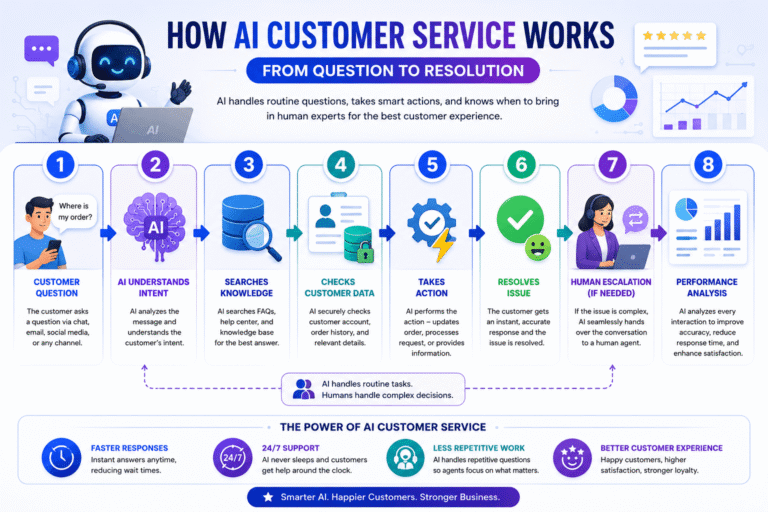
Step 4: Define Human Escalation Rules
Create clear rules for when AI must stop.
Escalate situations involving:
- Angry or distressed customers
- Complex refunds
- Security concerns
- Legal requests
- Sensitive account issues
- Exceptions to company policy
Step 5: Measure Results
Track:
- First-response time
- Resolution time
- Customer satisfaction
- AI resolution rate
- Escalation rate
- Cost per resolution
- Agent productivity
The goal is not simply to automate more conversations.
The goal is to solve customer problems better.
Real-World Examples: How Businesses Can Use AI Support
Ecommerce Example
Imagine a UK clothing store receiving hundreds of messages about delivery times.
Instead of manually answering every customer, an AI agent can identify the order, check its status, provide an update, and escalate delayed shipments.
SaaS Example
A software company may receive repetitive questions about password resets, billing, integrations, and account settings.
AI can handle basic requests while routing unusual technical problems to specialists.
International Business Example
A Canadian company selling products across Europe could use multilingual AI assistance to handle common questions while keeping human agents available for complex conversations.
The important point is simple: AI works best when it is connected to real business processes rather than functioning as a standalone chat window.
Expert Tips for Better AI Customer Support
Start small. Automate your easiest repetitive requests before attempting complicated workflows.
Train with real conversations. Your actual tickets reveal customer language that generic FAQs often miss.
Keep humans visible.** Customers should always have a clear path to human assistance.
Review failures. Every incorrect response is an opportunity to improve your knowledge base or workflow.
Measure outcomes. A chatbot that answers 90% of questions is not necessarily successful if customers still need to contact your team afterward.
> Key Takeaway: The best AI customer support strategy is a continuous improvement cycle: launch → measure → review → improve → expand.
Frequently Asked Questions
What are AI customer service tools?
AI customer service tools are platforms that use artificial intelligence to automate customer conversations, answer questions, assist human agents, summarize tickets, and complete support workflows. Modern AI agents can also connect with business systems to perform actions instead of simply displaying an answer.
Which AI customer service tool is best?
There is no single best option. Intercom Fin is strong for AI-first support, Zendesk AI suits complex support operations, Freshdesk Freddy AI works well for growing businesses, and Gorgias is particularly useful for ecommerce.
Can AI replace customer service agents?
AI can automate many repetitive support tasks, but it should not completely replace human agents. People remain important for complex problems, sensitive situations, exceptions, emotional conversations, and decisions requiring judgment.
Are AI customer service tools expensive?
Pricing varies significantly. Some platforms use per-seat pricing, while others add usage or outcome-based charges. For example, Intercom currently lists Fin at $0.99 per outcome alongside its platform plans.
How do I start using AI for customer support?
Start by analyzing your most common support requests. Choose a small group of low-risk, repetitive questions, connect your knowledge sources, define human escalation rules, test the AI, and measure resolution quality before expanding automation.
Conclusion
The best AI customer service tools do more than answer questions. They help businesses respond faster, reduce repetitive workload, support agents, and create smoother customer experiences.
Intercom Fin stands out for AI-first support. Zendesk is a strong choice for complex service operations. Freshdesk Freddy AI offers a balanced helpdesk and AI approach. Gorgias is especially compelling for ecommerce. HubSpot makes sense when customer service needs to stay closely connected to CRM data.
However, the software is only one part of the equation.
Your knowledge base, workflows, escalation rules, integrations, and human support strategy determine how successful the AI will actually be.
Start with one problem. Automate it carefully. Measure the outcome. Then expand.
That is how AI customer service becomes a genuine business advantage rather than just another technology experiment.
Add Your Heading Text Here
Lorem ipsum dolor sit amet, consectetur adipiscing elit. Ut elit tellus, luctus nec ullamcorper mattis, pulvinar dapibus leo.
Pingback: How to Automate Your Business with AI -