
Introduction
If you’ve recently started exploring artificial intelligence, you’ve probably come across the terms Machine Learning vs AI vs Deep Learning. Although they’re often used interchangeably, they don’t mean the same thing. Understanding the differences between AI vs Machine Learning is essential whether you’re a student, business owner, marketer, developer, or simply curious about emerging technology.
Artificial Intelligence (AI) is transforming industries worldwide—from healthcare and finance to retail and manufacturing. However, Machine Learning (ML) and Deep Learning (DL) are specialized branches within AI, each serving different purposes and requiring different approaches.
In this guide, you’ll discover what each technology means, how they relate to one another, their real-world applications, and how to determine which one best fits different business and technology challenges.
Table of Contents
- What Are AI, Machine Learning, and Deep Learning?
- Why Understanding the Difference Matters
- Artificial Intelligence Explained
- Machine Learning Explained
- Deep Learning Explained
- Key Differences Between AI, ML, and DL
- Real-World Examples
- Benefits for Businesses
- Best Practices
- Common Mistakes
- Practical Checklist
- FAQs
- Conclusion
Why Understanding Machine Learning vs AI vs Deep Learning Matters
Technology is evolving rapidly, and organizations across the USA, Canada, Europe, and the UK are investing heavily in AI-powered solutions. However, making informed decisions requires understanding what each technology actually does.
Knowing the difference helps you:
- Choose the right technology for your business.
- Avoid unrealistic expectations about AI capabilities.
- Improve communication with developers and vendors.
- Select relevant learning paths if you’re entering the AI field.
- Make smarter investments in automation and data-driven solutions.
Whether you’re evaluating AI software or planning a digital transformation strategy, understanding concepts of AI vs Machine Learning can save both time and money.
What Is Artificial Intelligence (AI)?
Artificial Intelligence is the broadest concept of the three. It refers to computer systems designed to perform tasks that typically require human intelligence.
These tasks include:
- Learning
- Problem-solving
- Decision-making
- Language understanding
- Image recognition
- Speech recognition
- Planning
- Pattern recognition
Rather than following only fixed rules, AI systems can analyze information and make intelligent decisions based on available data.
Simple Example of AI
Imagine a virtual customer support assistant.
It can:
- Answer customer questions.
- Understand natural language.
- Recommend products.
- Escalate complex issues to human agents.
This entire system represents Artificial Intelligence.
Machine Learning and Deep Learning may power certain parts of it, but AI is the overall umbrella technology.
Common AI Applications
Artificial Intelligence is already part of everyday life.
Examples include:
- Voice assistants
- Recommendation engines
- Fraud detection
- Medical diagnosis support
- Smart home devices
- Self-driving vehicle technology
- Language translation
- Email spam filtering
Businesses increasingly rely on AI to improve customer experiences, reduce operational costs, and uncover insights from large datasets.
What Is Machine Learning (ML)?
Machine Learning is a subset of Artificial Intelligence.
Instead of programming every rule manually, developers train Machine Learning models using data. The system identifies patterns and improves its predictions over time.
In simple terms:
AI aims to make machines intelligent.
Machine Learning teaches machines how to learn from experience.
How Machine Learning Works
Machine Learning follows a structured process:
- Collect data.
- Clean and prepare the data.
- Train a model.
- Test its accuracy.
- Improve predictions with additional data.
Unlike traditional software, Machine Learning becomes more effective as it processes more relevant information.
Everyday Machine Learning Examples
You probably interact with Machine Learning every day.
Examples include:
- Netflix recommending movies.
- Spotify suggesting playlists.
- Amazon recommending products.
- Banks detecting unusual transactions.
- Email providers filtering spam.
- Search engines ranking relevant results.
These systems continuously improve because they learn from user behavior and historical data.
What Is Deep Learning?
Deep Learning is a specialized branch of Machine Learning.
It uses artificial neural networks, which are inspired by the way the human brain processes information.
These neural networks contain multiple layers that enable computers to recognize highly complex patterns without requiring extensive manual feature engineering.
Deep Learning has become the driving force behind many recent AI breakthroughs, including advanced language models, image generation, autonomous vehicles, and medical image analysis.
Why Is It Called “Deep” Learning?
The word deep refers to the many hidden layers within a neural network.
Each layer processes increasingly complex information.
For example, when identifying a dog in a photo:
- The first layer detects edges.
- The second identifies shapes.
- The next recognizes ears and eyes.
- Later layers identify the complete animal.
This layered learning process enables highly accurate image and speech recognition.
Common Deep Learning Applications
Deep Learning powers many advanced technologies, including:
- Facial recognition systems
- Medical imaging analysis
- Voice assistants
- Autonomous vehicles
- Chatbots and large language models
- Image generation tools
- Video analysis
- Real-time language translation
These applications require massive datasets and powerful computing resources, making Deep Learning particularly effective for solving complex problems that traditional Machine Learning struggles with.
Machine Learning vs AI vs Deep Learning: Understanding the Relationship
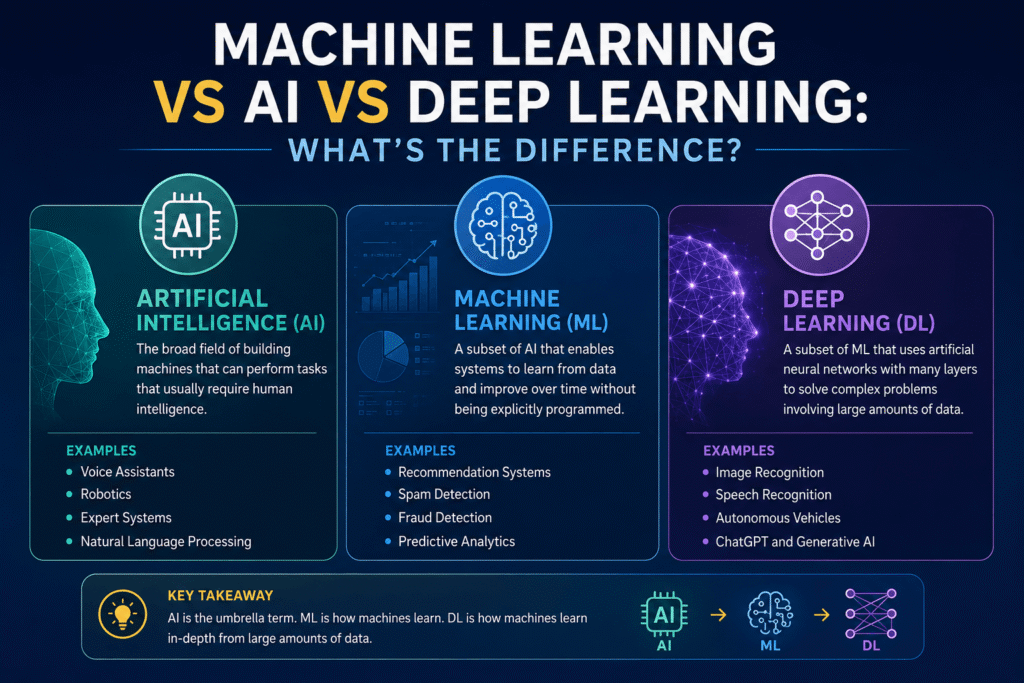
A simple way to visualize the relationship is as a set of nested categories:
- Artificial Intelligence is the broad field focused on creating intelligent systems.
- Machine Learning is a subset of AI that enables systems to learn from data.
- Deep Learning is a subset of Machine Learning that uses multi-layer neural networks to solve highly complex tasks.
Think of it like this:
- AI is the entire universe.
- Machine Learning is a planet within that universe.
- Deep Learning is a city on that planet.
Every Deep Learning system uses Machine Learning principles, and every Machine Learning solution belongs to the broader field of Artificial Intelligence. However, not every AI system relies on Machine Learning, and not every Machine Learning model uses Deep Learning.
Real-World Examples of AI, Machine Learning, and Deep Learning
The easiest way to understand the differences is through practical examples.
Artificial Intelligence Example
A customer service chatbot that:
- Answers common questions
- Routes complex issues to support agents
- Provides order updates
- Suggests relevant products
The chatbot is an AI application because it performs tasks that normally require human intelligence.
Machine Learning Example
An online retailer recommends products based on your browsing history and previous purchases.
The recommendation engine continuously improves as it learns from customer behavior.
Examples include:
- Amazon product recommendations
- Netflix movie suggestions
- Spotify playlists
Deep Learning Example
A self-driving car must:
- Detect pedestrians
- Read traffic signs
- Identify road markings
- Predict vehicle movement
- Make driving decisions in real time
This requires Deep Learning because enormous amounts of visual data must be processed instantly.
Benefits of AI, Machine Learning, and Deep Learning
Each technology offers unique advantages depending on your goals.
Benefits of Artificial Intelligence
- Automates repetitive work
- Improves customer service
- Supports faster decision-making
- Reduces operational costs
- Increases productivity
- Works 24/7 without fatigue
Benefits of Machine Learning
- Learns from historical data
- Improves prediction accuracy
- Detects trends and patterns
- Supports personalized experiences
- Optimizes marketing campaigns
- Enhances fraud detection
Benefits of Deep Learning
- Handles massive datasets efficiently
- Excels at image recognition
- Powers natural language processing
- Improves speech recognition
- Enables advanced automation
- Delivers high accuracy for complex tasks
How to Choose the Right Technology
If you’re planning a project or evaluating AI solutions, use this simple approach.
Step 1: Define Your Goal
Ask yourself:
- Do you want to automate tasks?
- Predict customer behavior?
- Analyze images or videos?
- Build conversational AI?
Your objective determines which technology fits best.
Step 2: Evaluate Your Data
Consider:
- How much data do you have?
- Is it structured or unstructured?
- Is the data clean and reliable?
Machine Learning performs well with structured datasets, while Deep Learning shines with large volumes of images, audio, video, or text.
Step 3: Consider Your Resources
Deep Learning often requires:
- Powerful GPUs
- Larger budgets
- Longer training times
- Specialized expertise
If your resources are limited, Machine Learning may provide a more practical starting point.
Step 4: Start Small and Scale
Many successful organizations begin with simple AI or Machine Learning projects before investing in more advanced Deep Learning solutions.
This approach reduces risk and delivers quicker business value.
Common Mistakes to Avoid
Many beginners misunderstand these technologies. Avoid these common pitfalls.
 Thinking AI and Machine Learning Are the Same
Machine Learning is only one branch of Artificial Intelligence.
Assuming Deep Learning Is Always Better
Deep Learning isn’t automatically the best choice.
For smaller datasets, traditional Machine Learning often produces faster, more cost-effective results.
Ignoring Data Quality
Even the most advanced AI model cannot compensate for poor-quality data.
Clean, accurate, and representative datasets are essential.
Focusing Only on Technology
Successful AI projects begin with solving a real business problem—not simply adopting the latest trend.
Expecting Instant Results
Building reliable AI systems requires testing, refinement, and continuous improvement.
Practical Checklist Before Starting an AI Project
Use this checklist before investing in Artificial Intelligence, Machine Learning, or Deep Learning.
✔ Define your business objective.
✔ Identify the problem you want to solve.
✔ Gather high-quality data.
✔ Choose the appropriate AI approach.
✔ Evaluate your available budget.
✔ Consider infrastructure requirements.
✔ Test models before deployment.
✔ Monitor performance regularly.
✔ Update models with new data.
✔ Ensure compliance with privacy and security regulations.
Ready to Learn More About Artificial Intelligence?
Understanding the difference between Artificial Intelligence, Machine Learning, and Deep Learning is the first step toward building valuable technical skills or making informed business decisions.
Whether you’re a student exploring AI, a professional looking to upskill, or a business evaluating AI solutions, continuous learning is essential.
 Explore more expert guides, tutorials, and AI learning resources on My AI Study Zone to stay ahead in the rapidly evolving world of artificial intelligence.
Frequently Asked Questions (FAQs)
What is the main difference between Machine Learning vs AI vs Deep Learning?
Artificial Intelligence is the broad concept of creating intelligent systems. Machine Learning is a subset of AI that learns from data, while Deep Learning is a specialized form of Machine Learning that uses neural networks to solve highly complex problems.
Is Deep Learning better than Machine Learning?
Not always. Deep Learning performs exceptionally well with large datasets and complex tasks like image recognition, while Machine Learning is often more efficient for structured data and simpler prediction problems.
Can AI exist without Machine Learning?
Yes. Traditional AI systems can use predefined rules and logic without learning from data. Machine Learning is one approach used within AI, but it is not the only one.
Which technology is used in ChatGPT?
ChatGPT is powered by Deep Learning, specifically large language models (LLMs) built on transformer neural network architectures. These models are part of the broader fields of Machine Learning and Artificial Intelligence.
Should beginners learn AI, Machine Learning, or Deep Learning first?
Most beginners should start with Artificial Intelligence fundamentals, then learn Machine Learning concepts before moving on to Deep Learning. This progression builds a strong understanding of how these technologies relate to one another.
Conclusion
Understanding Machine Learning vs AI vs Deep Learning is essential in today’s technology-driven world. While these terms are often used interchangeably, they represent different levels of intelligence and complexity within modern computing.
Artificial Intelligence is the overarching field focused on creating intelligent systems. Machine Learning enables those systems to learn from data and improve over time. Deep Learning takes this a step further by using sophisticated neural networks to solve highly complex problems involving images, speech, and natural language.
Whether you’re planning an AI-powered business solution, starting a career in data science, or simply exploring emerging technologies, knowing when and how each approach is used will help you make smarter decisions.
As AI continues to evolve, a clear understanding of these core concepts will become even more valuable. Keep learning, experiment with real-world tools, and build a strong foundation that prepares you for the future of intelligent technology.
Pingback: 10 Real-Life Examples of Artificial Intelligence