
Introduction
Writing a high-quality academic essay requires much more than good grammar. Students today are expected to conduct thorough research, develop evidence-based arguments, cite reliable sources, and present their ideas in a clear and logical format. Whether you’re studying at a university in the USA, Canada, the UK, or Europe, balancing these expectations with deadlines can be challenging.
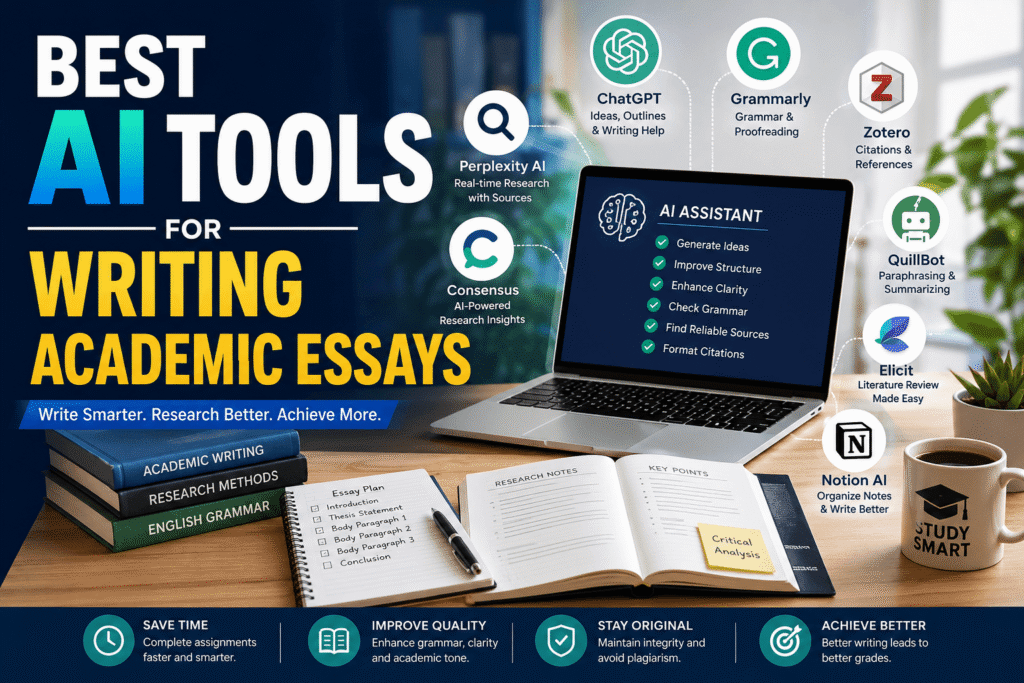
Fortunately, the **Best AI Tools for Writing Academic Essays** can make the writing process more efficient without replacing your own knowledge and critical thinking. Modern AI-powered writing assistants help students brainstorm ideas, organize research, improve grammar, generate citations, and refine their final drafts.
The key is using these tools responsibly. AI should enhance your learning, not complete your assignments for you. When used ethically, AI can save hours of work while helping you become a stronger writer.
In this guide, you’ll discover the best AI tools available in 2026, learn how each one supports academic writing, and find practical tips for using them effectively while maintaining academic integrity.
Table of Contents
1. Why AI Matters in Academic Writing
2. What Makes a Great AI Essay Writing Tool?
3. Best AI Tools for Writing Academic Essays
4. Benefits of AI Writing Tools
5. Best Practices for Responsible AI Use
6. Common Mistakes to Avoid
7. Academic Writing Checklist
8. Helpful Resources
9. Frequently Asked Questions
10. Final Thoughts
Why AI Matters in Academic Writing
Academic writing has evolved significantly over the past decade. Essays are no longer judged solely on grammar and formatting—they are evaluated for originality, critical thinking, evidence, and logical structure.
At the same time, students face increasing workloads, multiple deadlines, and growing expectations to produce high-quality assignments. This is where AI writing tools provide meaningful support.
Instead of replacing the writing process, AI helps students work more efficiently by handling repetitive tasks and providing intelligent suggestions.
For example, AI can assist with:
- Brainstorming essay topics
- Creating structured outlines
- Improving sentence clarity
- Correcting grammar and punctuation
- Summarizing research papers
- Organizing references
- Generating citation formats
- Identifying weak arguments
- Simplifying complex concepts
These capabilities allow students to focus on analysis and original thinking rather than spending excessive time on formatting and editing.
What Makes a Great AI Tool for Academic Essays?
Not every AI writing assistant is designed for academic work. Some are better suited for marketing copy or casual writing, while others provide features specifically tailored to students and researchers.
When evaluating AI tools, consider the following factors.
Accuracy
Reliable tools provide accurate information and encourage users to verify facts instead of generating unsupported claims.
Research Support
The best AI assistants help users discover trustworthy academic sources rather than relying on unverified online content.
Citation Features
Proper referencing is essential in higher education. Strong AI tools either integrate with citation managers or simplify bibliography creation.
Grammar and Readability
Academic writing should be formal, clear, and concise. AI should improve readability without changing the meaning of your work.
Privacy
Students should choose platforms that respect user privacy and protect uploaded documents.
Ease of Use
An intuitive interface allows users to focus on writing instead of learning complex software.
Best AI Tools for Writing Academic Essays
1. ChatGPT – The Most Versatile AI Writing Assistant
When discussing the Best AI Tools for Writing Academic Essays, ChatGPT consistently ranks among the top choices because of its flexibility.
Rather than generating entire essays, ChatGPT is most valuable as a collaborative writing assistant. It helps students organize ideas, explain difficult concepts, improve sentence structure, and create logical essay outlines.
Best Features
- Brainstorming essay topics
- Creating structured outlines
- Explaining difficult theories
- Improving paragraph flow
- Simplifying technical language
- Suggesting stronger transitions
- Editing drafts
Example Use Case
Imagine you’re writing an essay about climate change policy. Instead of asking AI to write the essay, you could ask:
“Create an outline comparing carbon taxes and cap-and-trade systems.”
The AI provides a structured framework that you can expand with your own research and analysis.
This approach supports learning while maintaining originality.
Pros
- Excellent idea generation
- Supports multiple academic subjects
- Great for editing
- Saves time
- Easy to use
Limitations
- Can occasionally generate incorrect facts
- Sources should always be verified
- Does not replace academic research
2. Grammarly – Best AI Tool for Editing Academic Writing
Even experienced writers make grammar mistakes.
Grammarly remains one of the most trusted AI writing assistants because it improves clarity without changing your personal writing style.
Unlike basic spell checkers, Grammarly analyzes:
- Grammar
- Punctuation
- Tone
- Readability
- Sentence structure
- Word choice
- Academic style
It also identifies passive voice, repetitive wording, and overly complex sentences, making essays easier to read while maintaining a professional tone.
Best For
- Final proofreading
- Grammar correction
- Readability improvements
- Academic editing
Many universities recommend proofreading tools before submission, making Grammarly a valuable final step in the writing process.
3. Zotero – Best AI-Assisted Citation Manager
One of the biggest challenges in academic writing is managing references accurately. Incorrect citations can affect your grades and even lead to academic misconduct.
Zotero is a free research management tool that helps students collect, organize, cite, and share research sources efficiently. While Zotero isn’t an AI writing assistant in the traditional sense, its intelligent reference management capabilities make it an essential tool for academic writing.
Key Features
- Save journal articles with one click
- Generate APA, MLA, Harvard, Chicago, and IEEE citations
- Automatically build bibliographies
- Organize research into collections
- Sync references across multiple devices
- Integrates with Microsoft Word and Google Docs
Best For
- Research papers
- Literature reviews
- Dissertations
- Thesis writing
Pro Tip: Pair Zotero with ChatGPT to streamline your workflow—use ChatGPT to refine your ideas and Zotero to manage and format your citations accurately.
4. Perplexity AI – Best for Finding Reliable Information
Perplexity AI stands out because it provides answers alongside referenced sources, making it easier to verify information before including it in an essay.
Instead of presenting unsupported responses, Perplexity links to reputable websites, research papers, and academic publications.
Best Features
- Real-time web search
- Source-backed answers
- Follow-up questions
- Research summaries
- Easy navigation through cited material
Best For
- Research projects
- Current affairs essays
- Evidence gathering
- Exploring different perspectives
Although Perplexity simplifies research, always review the original source before quoting or citing it.
5. Consensus – Best AI Tool for Research-Based Essays
Consensus is designed specifically for academic research. Unlike many AI chatbots, it searches peer-reviewed scientific literature instead of relying on general web content.
This makes it an excellent resource for students who need evidence-backed information.
Key Benefits
- Searches scientific publications
- Summarizes research findings
- Reduces time spent reviewing papers
- Helps identify academic consensus on a topic
Ideal For
- Psychology
- Medicine
- Education
- Business
- Environmental Science
- Engineering
If your assignment requires scholarly evidence, Consensus can save significant research time while improving the quality of your references.
6. QuillBot – Best AI Tool for Paraphrasing
Strong academic writing often involves rewriting complex ideas in your own words. QuillBot helps improve sentence structure while preserving the original meaning.
Features
- Paraphrasing modes
- Grammar checker
- Summarizer
- Citation generator
- Vocabulary enhancement
Responsible Use
QuillBot should never be used to disguise copied content. Instead, use it to improve clarity after you’ve written your own explanation.
Good academic writing reflects your understanding, not simply rewritten text.
7. Elicit – Best for Literature Reviews
Students writing dissertations or research papers often spend hours searching for relevant journal articles.
Elicit accelerates this process by identifying studies, extracting key findings, and summarizing research.
Why Researchers Like Elicit
- AI-powered literature search
- Evidence extraction
- Research summaries
- Comparison of studies
- Question-based search
This makes it particularly useful for postgraduate students and researchers.
8. Notion AI – Best for Organizing the Writing Process
Academic success depends on more than writing. Planning, note-taking, and time management are equally important.
Notion AI helps students organize every stage of an assignment.
Useful Features
- Research databases
- Assignment trackers
- Essay outlines
- Study schedules
- Project planning
Students juggling multiple courses can use Notion AI as a centralized academic workspace.
Using AI responsibly can improve both writing quality and productivity.
1. Saves Time
Students spend less time on repetitive tasks such as grammar correction, citation formatting, and outline creation.
2. Improves Writing Quality
AI identifies awkward phrasing, grammatical errors, and readability issues that are easy to overlook during self-editing.
3. Supports Better Research
Research-focused AI tools help students locate reliable information more efficiently than traditional search methods.
4. Encourages Better Organization
Planning essays with AI-generated outlines reduces writer’s block and improves logical structure.
5. Builds Confidence
Many students struggle with academic writing, especially when English is not their first language. AI tools provide constructive suggestions that help users write with greater confidence.
Best Practices for Using AI Responsibly
To get the most value from AI while maintaining academic integrity, follow these best practices.
Start With Your Own Ideas
Always begin by understanding the assignment and developing your own thesis before using AI for support.
Verify Every Fact
AI systems can occasionally provide outdated or inaccurate information. Cross-check facts using trusted academic sources.
Cite Sources Properly
AI does not replace the need for proper referencing. Use citation tools and follow your institution’s required citation style.
Edit Every AI Suggestion
Treat AI output as a first draft or assistant—not the final version of your work.
Review every paragraph to ensure it reflects your own understanding.
Follow University Policies
Many universities now publish guidelines on AI usage. Familiarize yourself with these rules before submitting assignments.
Common Mistakes to Avoid
Students often misuse AI tools by relying on them too heavily.
Avoid these common mistakes:
- Copying AI-generated text without editing
- Failing to verify references
- Ignoring university AI policies
- Using AI instead of conducting research
- Overusing paraphrasing tools
- Forgetting plagiarism checks
- Accepting incorrect AI responses as facts
Responsible AI use enhances learning rather than replacing it.
Practical Academic Writing Checklist
Before submitting your essay, review the following checklist:
 Developed an original thesis statement
Conducted independent research
Verified all facts and statistics
Used credible academic sources
Formatted citations correctly
Reviewed grammar and readability
Checked originality
Followed university AI guidelines
Proofread the final draft
Frequently Asked Questions (FAQ)
What are the best AI tools for writing academic essays?
Some of the best AI tools for academic writing include ChatGPT, Grammarly, Zotero, Perplexity AI, Consensus, QuillBot, Elicit, and Notion AI. Each tool supports a different stage of the writing process, from research and outlining to editing and citation management.
Can AI write my university essay?
AI can assist with brainstorming, outlining, grammar, and editing. However, students should always write original content, verify information, and follow their institution’s academic integrity policies.
Is using AI for academic essays considered plagiarism?
Using AI is not automatically plagiarism. Problems arise when AI-generated content is submitted as your own without review or when it violates your institution’s rules. Always ensure your final work is original and properly cited.
Which AI tool is best for citations?
Zotero is widely regarded as one of the best tools for managing references and generating citations in APA, MLA, Chicago, Harvard, and other academic styles.
How can I use AI responsibly in academic writing?
Use AI to improve grammar, organize ideas, summarize research, and refine drafts. Always verify facts, cite sources correctly, and make sure your final essay reflects your own understanding and analysis.
Conclusion
The Best AI Tools for Writing Academic Essays are transforming the way students approach research, writing, and editing. From generating structured outlines with ChatGPT to managing references in Zotero and polishing grammar with Grammarly, today’s AI solutions can significantly improve productivity without compromising academic standards.
However, the most successful students use AI as a partner—not a replacement for critical thinking. Strong academic writing still depends on original ideas, credible research, and thoughtful analysis.
By combining responsible AI use with effective study habits, you can produce well-organized, evidence-based essays while developing valuable writing skills that will benefit you throughout your academic and professional journey.
If you’re ready to explore more AI-powered learning resources, visit My AI Study Zone and discover tools, tutorials, and guides designed to help you succeed.
Pingback: Machine Learning vs AI vs Deep Learning Explained
Pingback: 10 Real-Life Examples of Artificial Intelligence
Pingback: How ChatGPT Works: A Beginner-Friendly Explanation -