
Introduction
How to summarize research papers using AI has become one of the most searched topics among students, researchers, educators, and professionals. Academic literature is expanding at an incredible pace, making it increasingly difficult to keep up with new findings while balancing coursework, research projects, or professional responsibilities.
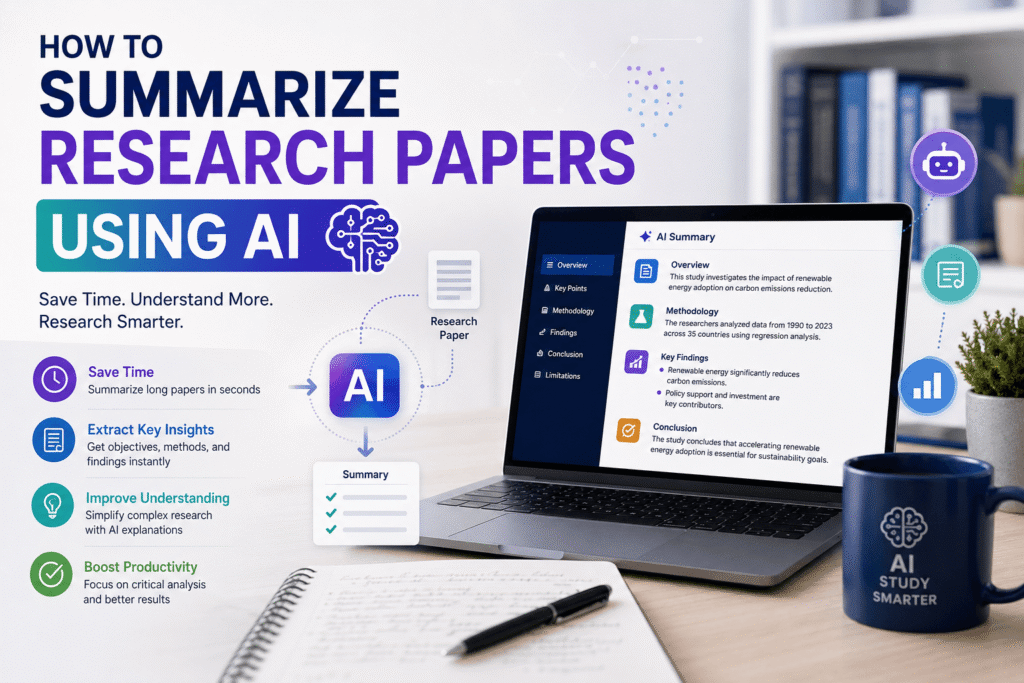
Artificial intelligence is transforming the way people read and understand complex academic papers. Instead of spending hours reading every section from beginning to end, AI-powered tools can quickly identify the main objectives, methodology, findings, and conclusions. Used correctly, these tools save time while helping readers focus on understanding rather than simply extracting information.
However, AI should enhance critical thinking—not replace it. This guide explains how to use AI responsibly to summarize research papers, improve your study workflow, and produce better academic insights without sacrificing accuracy.
Table of Contents
- Why AI Research Summaries Matter
- What AI Research Paper Summarizers Actually Do
- Benefits of Using AI for Academic Reading
- Step-by-Step Guide to Summarizing Research Papers Using AI
- Best Practices for High-Quality AI Summaries
- Common Mistakes to Avoid
- Practical Checklist
- Link Placement Suggestions
- Call to Action
- FAQs
- Conclusion
Why AI Research Summaries Matter
Every year, millions of scientific papers are published across medicine, engineering, business, education, technology, psychology, and countless other fields. Keeping up with this growing volume of information is becoming increasingly challenging.
Reading every paper in full simply isn’t practical for most people. Researchers often need to review dozens—or even hundreds—of studies before completing a literature review. Students face tight deadlines, while professionals need reliable insights without investing excessive time.
AI-powered summarization addresses these challenges by helping users:
- Identify the purpose of a paper quickly
- Understand the main findings
- Recognize key methodologies
- Decide whether a paper deserves a full read
- Compare multiple studies more efficiently
Rather than replacing academic reading, AI serves as a productivity assistant that streamlines the early stages of research.
What AI Research Paper Summarizers Actually Do
What AI Research Paper Summarizers Actually Do
AI summarization tools rely on advanced natural language processing (NLP) and large language models to analyze the structure and meaning of academic text. Instead of merely shortening sentences, modern AI systems identify relationships between concepts, recognize technical terminology, and highlight the most important information.
Most quality AI summarizers extract:
Research Objective
What question is the study trying to answer?
Background
Why was the research conducted?
Methodology
How was the research performed?
Key Findings
What were the major discoveries?
Conclusion
What practical or scientific conclusions can be drawn?
Some advanced tools can also explain difficult terminology in simpler language, making academic papers more accessible to beginners.
Example:
Instead of reading a 25-page medical research article, an AI tool may generate a concise one-page overview covering the study’s purpose, participant group, methods, results, and limitations. This allows readers to decide whether a deeper review is necessary.
Benefits of Using AI for Academic Reading
AI offers far more than simple time savings. When integrated into a thoughtful research process, it can significantly improve productivity and learning outcomes.
Save Valuable Time
Researchers often spend hours screening papers before identifying relevant sources. AI dramatically reduces this initial workload by generating quick summaries that help prioritize reading.
Improve Information Retention
Well-structured summaries make it easier to remember key concepts, research findings, and important terminology.
Simplify Complex Language
Many scientific papers use highly technical vocabulary. AI can explain complex ideas in plain English, making them easier to understand for students and non-specialists.
Increase Research Efficiency
AI helps readers compare multiple papers more quickly by presenting key findings in a consistent format.
Support Literature Reviews
During literature reviews, researchers often analyze dozens of related studies. AI-generated summaries provide a useful starting point for organizing evidence before deeper evaluation.
Enhance Study Sessions
Students can review summaries before lectures, exams, or group discussions, allowing them to engage more confidently with the material.
Step-by-Step Guide to Summarizing Research Papers Using AI
Following a structured workflow ensures that AI enhances your research rather than introducing misunderstandings.
Step 1: Choose a Reliable Research Paper
Begin with credible academic sources such as peer-reviewed journals, conference proceedings, or reputable databases.
Examples include:
- Google Scholar
- PubMed
- University libraries
- Government research repositories
Using high-quality source material leads to more reliable AI summaries.
Step 2: Upload or Paste the Paper into an AI Tool
Most AI summarization platforms allow users to:
- Upload PDF files
- Paste text
- Import research links
- Analyze documents directly
Choose the method that best fits your workflow.
Step 3: Request a Structured Summary
Instead of asking AI to “summarize this paper,” provide more specific instructions.
For example:
- Summarize the objectives.
- Explain the methodology.
- List the key findings.
- Identify study limitations.
- Highlight practical implications.
Specific prompts usually produce clearer and more useful summaries.
Step 4: Verify the Results
Never assume that an AI-generated summary is perfectly accurate.
Always compare the summary against:
- The abstract
- The conclusion
- Important figures
- Tables
- Key data points
Verification helps prevent misunderstandings or missing context.
Step 5: Add Your Own Notes
AI should be the starting point—not the final product.
As you read, record:
- Questions
- Observations
- Contradictions
- Connections to previous research
- Ideas for future study
These personal insights strengthen understanding and support original thinking.
Best Practices for High-Quality AI Summaries
Using AI effectively requires thoughtful habits. The following best practices can improve both accuracy and learning outcomes.
Read the Abstract First
The abstract provides valuable context before using AI. Understanding the study’s purpose helps you evaluate whether the generated summary captures the main message accurately.
Use Multiple Sources
Avoid relying on a single paper when researching a topic. Comparing summaries from several studies provides a broader perspective and reduces the risk of drawing conclusions from one piece of evidence.
Check Citations and References
Even if AI summarizes a paper well, it should never replace proper citation practices. Always consult the original source when quoting, referencing findings, or writing academic work.
Review Important Visuals
Charts, graphs, and tables often contain information that AI may not fully explain. Spend a few minutes reviewing these sections to ensure you understand the evidence supporting the study’s conclusions.
Keep Human Judgment at the Center
AI is an excellent assistant, but it cannot replace subject expertise, critical thinking, or academic integrity. Treat every AI-generated summary as a draft that should be reviewed, refined, and validated before use.
Common Mistakes to Avoid When Using AI for Research Paper Summaries
AI can significantly improve your research workflow, but it’s not infallible. Understanding its limitations will help you avoid common pitfalls and produce more accurate, reliable work.
1. Relying Only on the AI Summary
An AI-generated summary is designed to provide an overview—not a complete understanding of a research paper. Important details, such as limitations, statistical significance, or nuanced arguments, may be simplified or omitted.
Always review the abstract, conclusion, and any sections directly related to your research question.
2. Accepting Information Without Verification
Even advanced AI tools can occasionally misinterpret data or generate inaccurate statements. Before citing or sharing information, compare the summary with the original paper to confirm its accuracy.
3. Ignoring Study Limitations
Every research paper has limitations, including sample size, methodology, geographic scope, or potential bias. AI may focus primarily on findings and overlook these critical details.
Understanding a study’s limitations helps you evaluate how applicable its conclusions are to your own work.
4. Using AI to Replace Critical Thinking
AI is most effective when it complements your analytical skills. Instead of accepting every output at face value, ask questions such as:
- Does this conclusion align with the evidence?
- Were the research methods appropriate?
- Are there conflicting studies on the same topic?
- What assumptions might the authors have made?
Developing these habits strengthens your research skills and improves decision-making.
5. Forgetting Academic Integrity
If you’re writing an assignment, dissertation, or professional report, always cite the original research paper rather than the AI-generated summary. AI should support your understanding—not replace proper attribution or original analysis.
Practical Checklist for Summarizing Research Papers Using AI
Use this checklist each time you analyze a research paper to ensure a consistent and reliable workflow.
Before You Start
- Select a credible, peer-reviewed research paper.
- Read the title and abstract.
- Identify the research objective.
- Decide what information you need from the paper.
While Using AI
- Upload the complete document or relevant sections.
- Request a structured summary.
- Ask AI to explain unfamiliar terminology.
- Generate key takeaways and practical implications.
- Identify research limitations.
After Receiving the Summary
- Compare the summary with the original paper.
- Review charts, tables, and figures.
- Add your own notes and observations.
- Save the summary with proper citations.
- Organize summaries for future reference.
Following a repeatable process will save time while maintaining academic quality.
Ready to Improve Your AI Study Workflow?
Learning how to summarize research papers using AI is only one part of becoming a more efficient learner or researcher. Choosing the right AI tools, understanding their strengths, and using them responsibly can dramatically improve your productivity without compromising academic quality.
At My AI Study Zone, we provide practical guides, tool comparisons, study strategies, and AI-powered learning resources designed to help students, researchers, educators, and professionals work smarter.
Whether you’re preparing a literature review, writing a thesis, or simply trying to stay current with the latest research, we’re here to help you make AI work for you.
Call to Action
Ready to take your research workflow to the next level?
Visit My AI Study Zone to explore expert guides, discover the latest AI study tools, and learn practical strategies that save time while improving learning outcomes. Stay informed, study smarter, and unlock the full potential of AI in education.
Frequently Asked Questions
What is the best way to summarize research papers using AI?
The most effective approach is to use AI to create a structured summary, then verify it against the original paper. Reviewing the abstract, methodology, findings, and conclusion ensures accuracy while allowing AI to save valuable time.
Can AI accurately summarize academic research papers?
Modern AI tools can produce highly useful summaries, but they are not perfect. Always review the original paper to confirm important details, statistics, and research limitations before relying on the summary.
Is using AI for research summaries considered plagiarism?
Using AI to understand a research paper is generally acceptable. However, copying AI-generated text into academic work without proper attribution or failing to cite the original source may violate academic integrity policies.
Which types of research papers work best with AI summarization?
AI performs well with scientific articles, journal publications, conference papers, medical studies, technical reports, and many other structured academic documents. Complex or highly specialized topics may require additional human review.
Can AI replace reading an entire research paper?
No. AI summaries are best used as a starting point. They help you identify whether a paper is relevant, but reading the full paper remains essential when conducting detailed research, writing literature reviews, or citing findings.
Conclusion
Knowing how to summarize research papers using AI is becoming an essential skill in today’s information-driven world. With thousands of academic papers published every day, AI offers an efficient way to identify relevant studies, understand complex topics, and streamline your research process.
The key to success is using AI responsibly. Treat AI-generated summaries as a helpful guide, verify important information against the original source, and apply your own critical thinking throughout the research process. By combining human expertise with AI-powered efficiency, you can save time, improve comprehension, and make better-informed decisions.
Whether you’re a student preparing for exams, a researcher conducting a literature review, or a professional staying informed about industry developments, AI can become a valuable partner in your learning journey when used thoughtfully.
Pingback: Best AI Tools for Writing Academic Essays (2026 Guide)
Pingback: AI Ethics for Students: Is AI Homework Ethical?