Introduction: Is AI Helping Students—or Slowly Replacing Learning?
What if the tool helping a student finish an assignment faster is also preventing that student from learning how to solve problems independently?
That is one of the biggest questions surrounding the AI risks in education today.
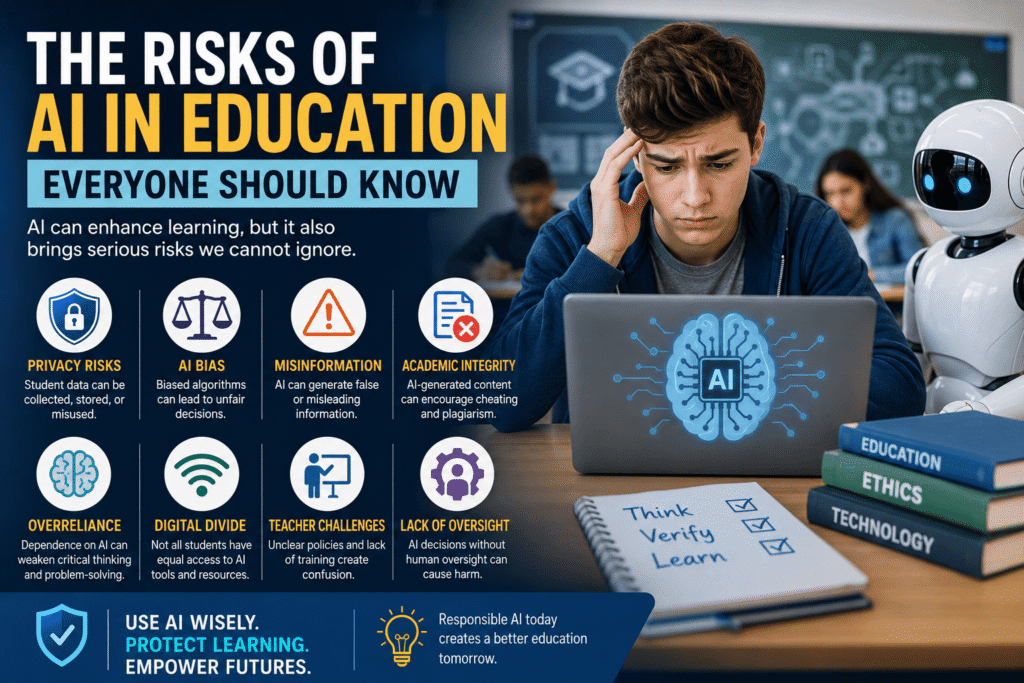
Artificial intelligence can explain difficult concepts, personalize learning, help teachers create materials, and make education more accessible. However, the same technology can introduce privacy problems, biased decisions, misinformation, academic dishonesty, and a dangerous dependence on automated answers.
UNESCO’s recent work on AI and education highlights concerns around privacy, equity, safety, bias, governance, and unequal access. In 2024, around 2.6 billion people worldwide still lacked internet access, showing how AI could potentially create an even deeper digital divide.
The goal is not to make students or educators afraid of AI.
The goal is to understand its weaknesses before relying on it.
In this guide, you will learn the major risks of AI in education, real-world examples, warning signs, and practical strategies for using AI responsibly.
Table of Contents
1. Why AI Risks in Education Matter
2. What Are the Biggest Risks of AI in Education?
3. Student Privacy and Data Security
4. AI Bias and Unfair Educational Decisions
5. AI Hallucinations and Misinformation
6. Academic Integrity and AI Cheating
7. Overreliance and Loss of Critical Thinking
8. The AI Digital Divide
9. Teacher and Student Challenges
10. Benefits of Responsible AI Use
11. How to Reduce AI Risks in Education
12. Common Mistakes to Avoid
13. Practical AI Safety Checklist
14. FAQ
15. Conclusion
What Is AI in Education?
Artificial intelligence in education refers to AI-powered technologies used to support teaching, learning, assessment, accessibility, and educational administration. These systems can provide explanations, generate educational materials, personalize learning activities, and assist teachers with repetitive tasks.
Examples include:
- AI tutors
- Generative AI chatbots
- Writing assistants
- Automated feedback tools
- Adaptive learning platforms
- AI translation tools
- Personalized learning systems
- AI-powered research tools
The important distinction is simple:
> AI should support the learning process, not replace the learner or teacher.
Why Are Schools Allowing AI Tools?
AI tools are becoming part of everyday student life.
Jisc’s 2025 research found that students are using AI for writing, research, revision, presentations, planning, and understanding difficult topics. The same research found that students want clearer, course-specific guidance about what AI use is acceptable.
This creates an important opportunity for schools.
Instead of simply banning AI, educators can teach students how to use it responsibly.
AI Can Provide Additional Learning Support
A student struggling with algebra could ask an AI tool to explain a concept using a simpler example.
A student learning programming could ask for a hint instead of a complete solution.
A student learning English could use AI to identify grammar mistakes and explain why they are mistakes.
Used this way, AI can become an additional learning resource.
AI Can Help Teachers With Repetitive Tasks
Teachers can use AI to assist with:
- Brainstorming lesson ideas
- Creating practice questions
- Developing discussion prompts
- Organizing information
- Generating draft learning materials
- Adapting explanations for different ability levels
However, teachers should review AI-generated material before using it in class.
What Are the Benefits of AI in Classrooms?
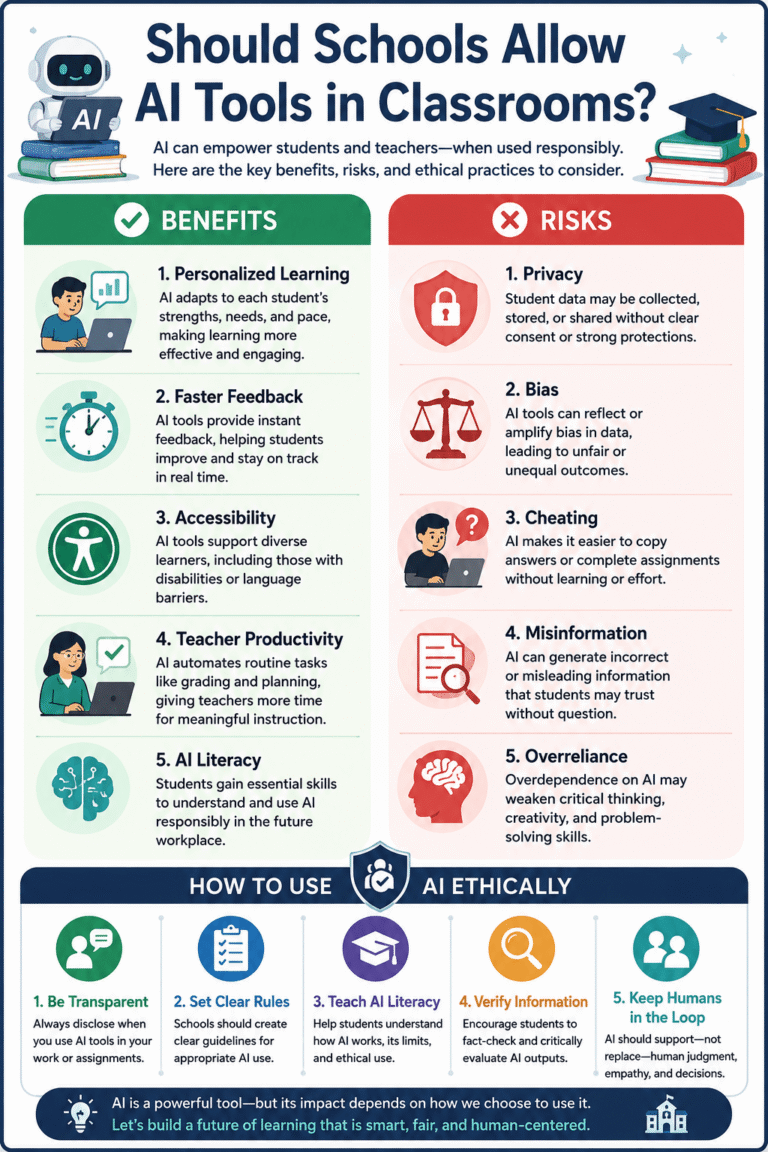
When used responsibly, AI can provide meaningful educational benefits.
Benefit How AI Can Help
Personalized learning Provides different explanations and practice
Faster feedback Gives immediate responses during practice
Accessibility Supports translation and language assistance
Teacher productivity Helps with repetitive preparation tasks
AI literacy Teaches students how to work with emerging technology
Engagement Creates interactive learning activities
Personalized Learning
Traditional classrooms often require one teacher to support many students simultaneously.
AI can provide additional explanations based on a student’s question or learning level.
For example, a student might ask:
> “Explain photosynthesis as if I’m 12 years old.”
Then the student can ask for a more advanced explanation.
This creates a flexible learning experience without requiring the teacher to repeat the same explanation individually.
Accessibility and Language Support
AI-powered translation, speech-to-text, text simplification, and other tools can help make educational content more accessible.
This can be particularly useful for multilingual learners and students who need additional forms of support.
Preparing Students for an AI-Powered Workplace
Students will likely encounter AI in many future careers.
Schools therefore have a responsibility to teach not only how to use AI, but also how to question it.
UNESCO’s AI ethics recommendation emphasizes AI literacy alongside critical thinking, creative thinking, communication, and other foundational skills.
Key Takeaway Box
> The goal should not be “more AI.” The goal should be better learning with appropriate AI.
What Are the Ethical Risks of AI in Education?
AI can create significant ethical challenges if schools introduce it without clear policies.
The major concerns include:
- Student privacy
- Data security
- Algorithmic bias
- Misinformation
- Academic dishonesty
- Overreliance
- Unequal access
- Lack of transparency
- Reduced human interaction
UNESCO’s guidance recommends that educational institutions evaluate AI through a human-centred approach that considers safety, equity, privacy, ethics, and educational value.
AI and Student Privacy
Student privacy is one of the most important issues in AI in education ethics.
AI platforms can potentially process information such as:
- Student names
- Assignments
- Academic performance
- Writing samples
- Learning behaviour
- Voice recordings
- Personal information
Why Does Student Data Matter?
Imagine a student uploads a personal essay to an AI platform.
The essay contains details about their family, experiences, school, and personal opinions.
If the school has not evaluated the platform’s privacy practices, the student may not know how that information is stored, processed, or retained.
That creates an ethical problem.
What Should Schools Do?
Before approving an AI tool, schools should examine:
- What information is collected
- How long information is stored
- Who can access the information
- Whether information is shared with third parties
- Whether users can delete their data
- Whether student information is used to train models
UNESCO specifically identifies data privacy as a central concern in the responsible use of generative AI in education.
AI Bias and Fairness in Education
AI systems learn patterns from data.
If the underlying data contains bias or does not adequately represent certain groups, AI systems can potentially produce unfair outcomes.
This matters when AI is used for:
- Student assessment
- Admissions
- Academic recommendations
- Scholarship decisions
- Learning predictions
- Automated feedback
Real-World Scenario
Imagine an AI system predicts which students are likely to need additional academic support.
If the historical data used to train the system reflects existing inequalities, the algorithm could reproduce those patterns.
The system might appear objective because it is automated.
But automation does not automatically mean fairness.
Key Takeaway Box
> A computer-generated decision is not automatically an unbiased decision. Human review still matters.
AI, Cheating, and Academic Integrity
Academic integrity is one of the biggest challenges associated with classroom AI.
Students can potentially use generative AI to:
- Write essays
- Generate code
- Complete homework
- Answer discussion questions
- Create presentations
- Solve problems
- Rewrite assignments
The important question is not simply:
“Did AI help?”
The better question is:
“Did the student still do the learning?”
The Real Problem Is Lost Learning
The Real Problem Is Lost Learning
Imagine a student receives a complete solution to a difficult programming problem from AI.
The assignment is finished.
But the student may not understand:
- Why the code works
- How to debug it
- How to modify it
- How to solve a similar problem independently
The student has completed the task without necessarily developing the skill.
The Real Problem Is Lost Learning
Imagine a student receives a complete solution to a difficult programming problem from AI.
The assignment is finished.
But the student may not understand:
- Why the code works
- How to debug it
- How to modify it
- How to solve a similar problem independently
The student has completed the task without necessarily developing the skill.
Acceptable vs Unacceptable AI Use
Potentially Appropriate Potentially Inappropriate
Brainstorming Submitting AI work as your own
Explaining a concept Completing a prohibited assignment
Practice questions Using AI during a prohibited exam
Grammar feedback Fabricating sources
Study planning Hiding required AI use
Exact rules should always depend on the school’s or teacher’s policy.
Jisc’s 2025 student research found that many students want clearer guidance about what counts as acceptable AI use and what crosses the line into cheating.
AI Hallucinations and Misinformation
AI can generate information that sounds convincing but is incorrect.
These errors are commonly called AI hallucinations.
Why Are Hallucinations Dangerous in Education?
Students may use AI to research:
- Historical events
- Scientific concepts
- Academic sources
- Statistics
- Current events
- Programming solutions
If an AI system produces an incorrect claim, students may unknowingly repeat it.
Even worse, AI can sometimes produce references that look legitimate but require verification.
How Students Should Verify AI Answers
Teach students to:
1. Ask AI for an explanation.
2. Identify important claims.
3. Check those claims against reliable sources.
4. Open the original source.
5. Compare information from multiple sources.
This transforms AI from an answer machine into a research starting point.
AI Overreliance and Critical Thinking
One of the biggest long-term concerns is dependence.
If students ask AI to solve every difficult problem, they get fewer opportunities to struggle productively.
They may gradually become less comfortable with:
- Problem-solving
- Research
- Writing
- Creativity
- Debugging
- Independent reasoning
Jisc’s 2025 research reports that some students were already noticing diminishing returns from heavy AI reliance and were reconsidering how they use AI for academic work.
Use AI as a Learning Partner
Instead of:
> “Solve this problem.”
Try:
> “Give me one hint.”
Instead of:
> “Write my essay.”
Try:
> “Help me create an outline and identify weaknesses in my argument.”
Instead of:
> “Give me the answer.”
Try:
> “Ask me questions that help me reach the answer.”
Key Takeaway Box
> If AI does all the thinking, students lose opportunities to practice thinking.
The AI Digital Divide
AI can improve access to educational support.
However, not every student has equal access to:
- Reliable internet
- Modern devices
- Premium AI tools
- Digital skills
- AI training
- Supportive learning environments
UNESCO reports that around 2.6 billion people were still offline in 2024, highlighting the continuing digital divide and the risk of an emerging AI divide.
Why Equal Access Matters
Suppose one student has access to a powerful paid AI platform while another student only has an older device and limited internet.
If AI becomes essential for completing coursework, the technology itself could create an unfair advantage.
Schools therefore need to consider accessibility before making AI part of required learning.
Should Schools Ban or Allow AI Tools?
There is no universal answer.
A complete ban can prevent students from learning responsible AI skills.
Unlimited access can increase risks involving cheating, privacy, misinformation, and dependency.
For many schools, the strongest approach is controlled and responsible AI use.
Summary Box
> The better question is not “AI or no AI?” It is “Which AI uses improve learning, and what safeguards are required?”
How Schools Can Use AI Ethically
1. Create Clear AI Policies
Policies should clearly explain:
- When AI is allowed
- When AI is prohibited
- Whether students must disclose AI assistance
- How AI-generated information should be checked
- What counts as academic misconduct
Students should not have to guess what their teacher considers acceptable.
2. Protect Student Data
Schools should approve only tools that meet their privacy and security requirements.
Students should also be taught what information should never be entered into public AI tools.
3. Teach AI Literacy
Students need to understand:
- How AI works at a basic level
- AI limitations
- Bias
- Hallucinations
- Privacy
- Copyright
- Source verification
- Prompting
- Responsible use
4. Keep Teachers in Control
AI can provide suggestions.
Teachers should remain responsible for important educational decisions.
5. Evaluate AI Tools Before Adoption
Schools should ask:
- Is this tool educationally useful?
- Is student data protected?
- Is it accessible?
- Can its outputs be verified?
- Could it introduce bias?
- Can teachers monitor its use?
6. Redesign Assessments
Schools can combine traditional assignments with:
- Presentations
- Discussions
- Practical demonstrations
- Oral assessments
- Projects
- Draft-based writing
- In-class activities
The goal is not simply to catch AI use.
The goal is to measure genuine understanding.
Common Mistakes Schools Should Avoid
Mistake 1: Allowing AI Without Rules
Students need clear expectations.
Mistake 2: Banning AI Completely
Students still need to develop AI literacy for further education and employment.
Mistake 3: Trusting AI as an Authority
AI outputs must be checked.
Mistake 4: Ignoring Privacy
Schools should never assume that every AI platform is appropriate for student information.
Mistake 5: Treating AI Detection as Perfect
AI detection tools should not automatically be treated as definitive proof of misconduct.
Human judgment and context remain important.
Mistake 6: Replacing Human Interaction
Education is more than information delivery.
Teachers provide encouragement, mentorship, feedback, emotional support, and context.
AI should strengthen those relationships—not eliminate them.
Expert Tip: Use the Human-in-the-Loop Model
A simple model can guide responsible classroom AI:
AI suggests → Teacher reviews → Student evaluates → Human makes the final decision
This keeps AI useful without giving it unnecessary authority.
UNESCO’s guidance similarly promotes a human-centred approach rather than treating AI as a substitute for human capacity.
Practical AI Classroom Checklist
Before introducing an AI tool, schools can ask:
Privacy
☐ Does the tool collect student information?
☐ How is the information stored?
☐ Can the data be deleted?
Accuracy
☐ Can important AI outputs be verified?
☐ Does the tool clearly communicate limitations?
Fairness
☐ Has the system been evaluated for bias?
☐ Could certain students be disadvantaged?
Academic Integrity
☐ Is AI use permitted?
☐ Must students disclose AI assistance?
Learning
☐ Does the tool improve understanding?
☐ Could students become dependent on it?
Human Oversight
☐ Can a teacher review important AI-generated results?
Frequently Asked Questions
Should schools allow AI tools in classrooms?
Yes, schools can allow AI tools when they establish clear rules, protect student data, train teachers, and maintain human oversight. Responsible access can help students develop AI literacy while reducing risks related to cheating, misinformation, privacy, and overreliance.
Is AI good or bad for education?
AI can be both helpful and harmful. It can support personalized learning, accessibility, and teacher productivity, but it can also create privacy, bias, misinformation, and academic-integrity concerns. The outcome depends largely on how the technology is implemented.
Can students use ChatGPT for schoolwork?
Students can use ChatGPT when their teacher or institution permits it. Appropriate uses may include brainstorming, explanations, practice, or feedback. However, submitting AI-generated work as original work can violate academic-integrity rules.
What are the biggest ethical concerns with AI in education?
The major concerns include student privacy, algorithmic bias, misinformation, academic dishonesty, unequal access, overreliance, lack of transparency, and reduced human interaction.
How can schools use AI responsibly?
Schools can use AI responsibly by creating clear policies, protecting student data, teaching AI literacy, verifying AI outputs, evaluating tools for fairness, and keeping teachers involved in important decisions.
Build a Smarter and More Responsible AI Learning Strategy
AI is already changing education.
The important question is whether schools will use it thoughtfully.
Instead of choosing between **”AI everywhere”** and **”AI completely banned,”** schools can create a balanced approach based on transparency, privacy, human oversight, and responsible use.
Explore My AI Study Zone for practical guides on AI, education, ethics, and responsible technology use.
Learn how AI works, understand its limitations, and develop the skills needed to use it wisely.
Conclusion
Schools should not approach artificial intelligence with blind enthusiasm or unnecessary fear.
The better approach is responsible adoption.
AI can personalize learning, support teachers, improve accessibility, and prepare students for an increasingly AI-powered world. At the same time, schools must address privacy, bias, misinformation, academic integrity, unequal access, and overreliance.
The future of AI in education ethics should therefore follow one simple principle:
> AI should empower education—not replace the people who make education meaningful.
When teachers remain involved, students remain active learners, and schools establish clear ethical boundaries, AI can become a powerful educational tool.
The goal is not to put AI at the centre of the classroom.
The goal is to put learning at the centre—and use AI where it genuinely helps.