Introduction
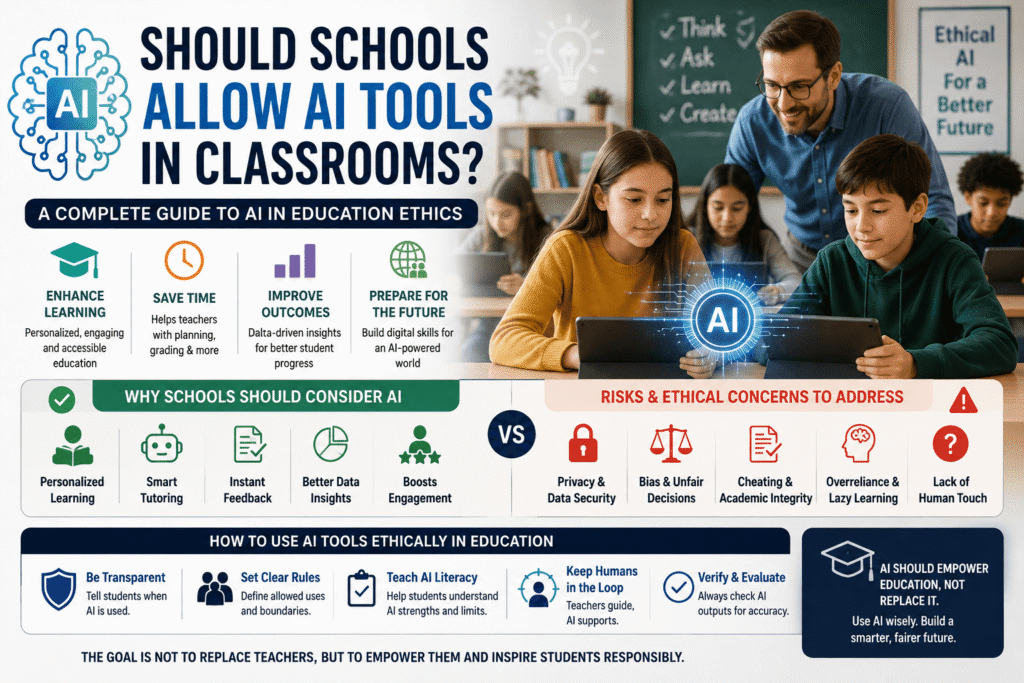
Did you know that more than half of students have already used AI tools to help with their schoolwork? As artificial intelligence becomes a normal part of everyday life, schools around the world face a difficult question: Should AI be welcomed into classrooms or restricted to protect academic integrity?
This debate is at the heart of AI in education ethics. While AI-powered tools like ChatGPT, Microsoft Copilot, and Google Gemini can improve learning, they also raise concerns about fairness, critical thinking, privacy, and cheating.
Teachers want technology that enhances education rather than replacing genuine learning. Parents want reassurance that AI will prepare students for future careers without harming essential skills. Meanwhile, students want smarter ways to learn without crossing ethical boundaries.
In this guide, you’ll discover how AI is transforming education, why ethical considerations matter more than ever, and how schools can create responsible AI policies that benefit everyone. You’ll also learn practical examples, expert insights, and proven strategies that help schools balance innovation with integrity.
📚 Table of Contents
- Why AI in Education Ethics Matters
- What Is AI in Education Ethics?
- Why Schools Are Adopting AI Tools
- AI Tools vs Traditional Learning (Comparison Table)
- Key Takeaways
- Real-World Case Study
Why AI in Education Ethics Matters
AI in education ethics refers to the responsible, fair, and transparent use of artificial intelligence in schools. It focuses on ensuring that AI supports learning without compromising privacy, academic honesty, fairness, or human decision-making.
Artificial intelligence is no longer a futuristic concept. It has become part of modern education across the USA, Canada, the UK, and Europe. Students now use AI to brainstorm ideas, summarize complex topics, practice foreign languages, generate quizzes, and receive personalized tutoring.
However, every technological breakthrough brings new ethical questions.
For example:
- Should AI help students write essays?
- Can teachers trust AI-generated assignments?
- Is it fair if some students have access to better AI tools than others?
- Who owns student data collected by AI platforms?
- How can schools prevent AI from spreading misinformation?
These questions highlight why AI in education ethics has become one of the most important discussions in modern education.
Instead of asking whether AI should exist in schools, educators are increasingly asking how it should be used responsibly.
📦 Summary Box
Why This Topic Matters
✔ AI is changing education faster than many schools can adapt.
✔ Ethical guidelines help students use AI responsibly.
✔ Teachers need clear policies to maintain academic integrity.
✔ Parents want technology that supports—not replaces—learning.
✔ Schools that adopt ethical AI practices are better prepared for the future.
What Is AI in Education Ethics?
AI in education ethics is the practice of using artificial intelligence responsibly in educational settings. It ensures AI promotes learning, protects student privacy, supports fairness, and complements teachers instead of replacing them.
AI systems can perform tasks that once required human intelligence. They can answer questions, generate lesson plans, provide instant feedback, translate languages, and personalize learning experiences.
Although these capabilities offer enormous benefits, they also introduce ethical challenges.
Ethical AI in education is built around several important principles:
Fairness
AI should provide equal opportunities for every student.
If an AI system favors certain groups because of biased training data, it may create unfair educational outcomes.
Transparency
Students and teachers should understand when AI is being used and how it reaches its recommendations.
Black-box decisions reduce trust.
Transparent AI builds confidence.
Privacy
Many AI platforms collect user information.
Schools must ensure student data remains secure and complies with regulations such as GDPR in Europe and other privacy frameworks.
Accountability
AI should assist educators—not replace them.
Teachers remain responsible for grading, mentoring, and making educational decisions.
Academic Integrity
Students should use AI to improve understanding instead of submitting AI-generated work as their own.
Responsible AI encourages learning rather than shortcuts.
💡Expert Tip
The most successful schools treat AI as a learning assistant rather than an answer machine. Students should explain, analyze, and evaluate AI-generated content instead of copying it.
Why Schools Are Beginning to Adopt AI Tools
Artificial intelligence offers opportunities that traditional teaching methods often cannot provide.
When used ethically, AI helps teachers save time while giving students more personalized support.
Some of the biggest reasons schools are embracing AI include:
Personalized Learning
AI adapts lessons based on each student’s strengths and weaknesses.
Instead of following the same pace for everyone, students receive customized explanations and practice activities.
Faster Feedback
Teachers often spend hours grading assignments.
AI can provide immediate feedback, allowing students to correct mistakes while concepts are still fresh.
Increased Accessibility
AI tools can:
- Translate languages
- Convert text into speech
- Generate captions
- Assist students with disabilities
- Simplify difficult reading materials
These features make education more inclusive.
Teacher Productivity
AI helps educators by:
- Creating quizzes
- Drafting lesson plans
- Generating classroom activities
- Producing discussion questions
- Summarizing educational resources
Instead of replacing teachers, AI reduces repetitive administrative work.
📌 Key Takeaways
✔ AI is transforming education across the world.
✔ Ethical guidelines are essential for responsible classroom AI use.
✔ Schools must balance innovation with academic integrity.
✔ Teachers remain central to learning, even when AI is involved.
✔ Responsible AI policies prepare students for future workplaces.
🌍 Real-World Case Study
How One School District Used AI Responsibly
A secondary school district introduced an AI-powered writing assistant for high school students. Instead of allowing students to submit AI-generated essays, teachers required them to use the tool only during brainstorming and editing.
Students had to:
- Highlight every AI-generated suggestion.
- Explain why they accepted or rejected each suggestion.
- Submit their first draft alongside the final version.
- Reflect on what they learned from using AI.
After one semester, teachers reported that students produced more organized writing while still demonstrating their own understanding and critical thinking. The district also developed clear classroom guidelines on transparency, citation, and appropriate AI use, helping build trust among students, parents, and educators.
Benefits of AI Tools in Classrooms
When used responsibly, AI tools can enhance learning by personalizing education, reducing teacher workload, improving accessibility, and preparing students for an AI-driven future. However, these benefits depend on ethical implementation and clear classroom policies.
Artificial intelligence is changing how students learn and how teachers teach. Rather than replacing traditional education, AI has the potential to make classrooms more engaging, efficient, and inclusive.
Let’s explore the biggest advantages.
1. Personalized Learning for Every Student
Every student learns differently.
Some understand concepts quickly, while others need additional explanations or practice. Traditional classrooms often struggle to meet every student’s individual needs because teachers have limited time.
AI-powered learning platforms can:
Adjust lesson difficulty automatically.
Recommend practice questions based on previous mistakes.
Identify weak areas.
Provide instant explanations.
Create customized study plans.
For example, a student struggling with algebra can receive extra practice questions, while another student who has mastered the topic can move on to more advanced problems.
This personalized approach helps students learn at their own pace without feeling left behind.
2. Supporting Teachers Instead of Replacing Them
One common misconception is that AI will replace teachers.
In reality, ethical AI is designed to assist educators, not replace the human relationships that are central to learning.
Teachers can use AI to:
Create lesson plans.
Design quizzes.
Generate classroom activities.
Summarize lengthy educational resources.
Draft parent communications.
Suggest differentiated learning activities.
By automating repetitive administrative tasks, teachers gain more time to mentor students, encourage creativity, and provide personalized support.
3. Better Accessibility and Inclusive Learning
AI can make education more accessible for students with diverse learning needs.
Examples include:
- Speech-to-text tools for students with mobility challenges.
- Text-to-speech software for visually impaired learners.
- Real-time translation for multilingual classrooms.
- Automatic captions for video lessons.
- Simplified reading materials for younger learners.
These features help create a more inclusive classroom where every student has a better opportunity to succeed.
4. Preparing Students for Future Careers
AI is becoming part of almost every industry, including healthcare, finance, engineering, law, and marketing.
Students who learn how to use AI responsibly today will be better prepared for tomorrow’s workforce.
Instead of avoiding AI, schools should teach students:
- How AI works.
- When AI should be used.
- When human judgment is essential.
- How to verify AI-generated information.
- How to use AI ethically in professional settings.
Learning these skills now can improve career readiness and digital literacy.
📦 Key Takeaways Box
Benefits of Ethical AI in Schools
✔ Personalized learning experiences.
✔ More time for teachers to focus on students.
✔ Better accessibility for diverse learners.
✔ Faster feedback on assignments.
✔ Improved digital literacy and future career skills.
Ethical Challenges of AI in Education
The biggest ethical concerns include academic dishonesty, biased AI outputs, student privacy, misinformation, unequal access to technology, and overdependence on AI. Schools must address these risks through clear policies and responsible use.
While AI offers exciting opportunities, it also introduces important ethical questions that educators cannot ignore.
1. Academic Integrity and Cheating
Perhaps the most discussed concern is whether students will rely on AI instead of developing their own skills.
Some students may:
- Submit AI-generated essays.
- Copy AI answers without understanding them.
- Use AI during exams.
- Skip critical thinking entirely.
This shifts education away from learning toward simply completing assignments.
Schools should encourage students to use AI for:
✔ Brainstorming
✔ Explaining difficult topics
✔ Practicing concepts
✔ Improving grammar
Instead of:
✖ Copying assignments
✖ Completing exams
✖ Generating entire projects without review
✖ Hiding AI-generated work
2. AI Bias and Fairness
AI systems learn from enormous datasets created by humans.
If those datasets contain historical or cultural bias, AI may unintentionally produce unfair recommendations.
Examples include:
- Gender stereotypes.
- Cultural bias.
- Language bias.
- Socioeconomic bias.
Students should understand that AI is not always objective.
They should question AI responses, compare multiple sources, and verify important information.
🌍 Real-World Case Study
Biased AI Recruiting Tools
Several organizations discovered that early AI recruitment systems favored certain applicants because they had been trained using historical hiring data. Although this example comes from employment rather than education, it highlights an important lesson for schools: AI can inherit human bias if it is not carefully designed and monitored.
Educators can use cases like this to teach students why critical thinking and human oversight remain essential whenever AI is involved.
3. Student Privacy and Data Protection
Many AI applications collect data to improve their services.
This may include:
- Student names.
- Learning progress.
- Writing samples.
- Voice recordings.
- Usage history.
Schools should carefully evaluate AI platforms before adoption.
Important questions include:
- What data is collected?
- Who owns the data?
- How long is it stored?
- Can students delete their information?
- Does the platform comply with privacy laws?
For schools in Europe, compliance with GDPR is especially important.
4. AI Can Produce Incorrect Information
AI is powerful, but it is not perfect.
Sometimes it generates answers that sound convincing but are inaccurate or completely fabricated.
This phenomenon is often called an AI hallucination.
Students should always:
- Verify facts.
- Cross-check multiple sources.
- Consult textbooks.
- Ask teachers when uncertain.
AI should support research—not replace reliable sources.
5. Unequal Access to AI Technology
Not every student has access to high-speed internet, modern devices, or premium AI tools.
This creates a digital divide.
If only some students benefit from advanced AI resources, educational inequality may increase.
Schools should ensure:
- Equal access to approved AI tools.
- Device availability where possible.
- Digital literacy training for all students.
Ethical AI should promote fairness rather than widen existing gaps.
Best Practices for Ethical AI Use in Schools
Schools should develop clear AI policies, teach AI literacy, encourage transparency, protect student data, and ensure teachers remain responsible for educational decisions.
Responsible AI begins with responsible leadership.
Schools can encourage ethical AI by following these best practices.
Create Clear Classroom AI Policies
Students should know:
- When AI is allowed.
- When AI is prohibited.
- How AI use should be disclosed.
- Which tools are approved.
Clear expectations reduce confusion and build trust.
Teach AI Literacy
Students should learn:
- How AI works.
- AI limitations.
- Bias in AI systems.
- Fact-checking skills.
- Responsible prompting.
Understanding AI is just as important as using it.
Encourage Transparency
Students should openly acknowledge when AI has helped them.
This promotes honesty while allowing teachers to assess genuine understanding.
Keep Humans in Control
Teachers should always make the final decisions regarding:
- Grading.
- Feedback.
- Assessment.
- Student support.
AI should assist—not replace—professional judgment.
 Expert Tips
Start small. Introduce one approved AI tool at a time and evaluate its impact before expanding usage.
Teach students to question AI answers. Critical thinking is more valuable than accepting AI responses at face value.
Focus on learning, not shortcuts. AI should enhance understanding, not replace effort.
📦 Summary Box
Building Ethical AI Classrooms
✔ Create transparent AI policies.
✔ Protect student privacy.
✔ Teach AI literacy alongside digital literacy.
✔ Encourage responsible AI use.
✔ Keep teachers at the center of education.
Common Mistakes Schools Should Avoid When Using AI
The biggest mistakes include adopting AI without clear policies, relying on AI for grading without human oversight, ignoring student privacy, and failing to teach AI literacy. Ethical AI requires thoughtful planning and continuous evaluation.
Even the best AI tools can create problems if schools implement them without proper guidelines. Avoiding these common mistakes helps ensure that AI supports education rather than undermining it.
1. Using AI Without a Clear Policy
Allowing AI in classrooms without explaining when and how it should be used leads to confusion among students and teachers.
Avoid this by:
- Publishing an AI use policy.
- Defining acceptable and unacceptable uses.
- Updating the policy regularly as technology evolves.
2. Treating AI as a Replacement for Teachers
AI can answer questions and automate tasks, but it cannot replace empathy, mentorship, classroom management, or human judgment.
Teachers should remain responsible for:
- Assessing student understanding.
- Providing emotional support.
- Encouraging collaboration.
- Making final academic decisions.
3. Ignoring AI Literacy
Many students know how to use AI but not how it works or why it can be wrong.
Schools should teach:
- AI limitations.
- Bias in AI.
- Prompt writing.
- Fact-checking.
- Responsible AI use.
4. Forgetting Student Privacy
Before introducing any AI platform, schools should evaluate:
- Data collection practices.
- Security measures.
- Compliance with local privacy regulations.
- Student consent requirements.
Protecting student information is a fundamental part of AI in education ethics.
📦 Summary Box
Avoid These Common Mistakes
 No AI policy
Blind trust in AI responses
Ignoring privacy concerns
Replacing teacher judgment
Encouraging dependency instead of learning
Ready to Navigate the Future of AI in Education?
Artificial intelligence is reshaping education, but ethical implementation is the key to long-term success. Whether you’re a teacher, student, parent, or school leader, staying informed will help you make smarter decisions about AI in the classroom.
At My AI Study Zone, we publish practical guides, expert insights, and beginner-friendly resources to help you understand AI with confidence.
 Explore more AI guides, bookmark this article, and subscribe to our newsletter to stay updated on the latest trends in ethical AI, education, and emerging technologies.
Frequently Asked Questions (FAQs)
1. Should schools allow AI tools in classrooms?
Yes, schools should allow AI tools when they are used responsibly. Clear policies, teacher supervision, and AI literacy ensure that AI enhances learning while protecting academic integrity.
2. What is AI in education ethics?
AI in education ethics refers to the responsible and fair use of artificial intelligence in schools. It focuses on privacy, transparency, academic honesty, fairness, and ensuring that AI supports rather than replaces human educators.
3. Can AI replace teachers?
No. AI can automate repetitive tasks and provide personalized support, but it cannot replace the human qualities of teachers, such as empathy, mentorship, creativity, and professional judgment.
4. What are the biggest risks of AI in education?
The main risks include academic dishonesty, biased AI outputs, misinformation, privacy concerns, unequal access to technology, and overreliance on AI instead of developing critical thinking skills.
5. How can schools use AI responsibly?
Schools can use AI responsibly by creating clear policies, teaching AI literacy, protecting student data, requiring transparency about AI use, and ensuring that teachers remain central to learning and assessment.
Conclusion
Artificial intelligence is no longer a distant innovation—it is becoming a natural part of modern education. The real question is not whether AI belongs in classrooms but how schools can use it responsibly to improve learning while preserving academic integrity and human connection.
Strong AI in education ethics ensures that technology serves students rather than controls them. By combining thoughtful policies, teacher oversight, AI literacy, and privacy protection, schools can create learning environments where innovation and responsibility go hand in hand.
The future of education is likely to be a partnership between human educators and intelligent technology. Schools that embrace this balanced approach will be better equipped to prepare students for an increasingly AI-driven world while nurturing the creativity, critical thinking, and ethical decision-making that only humans can truly develop.
Pingback: AI in education ethics