
Introduction
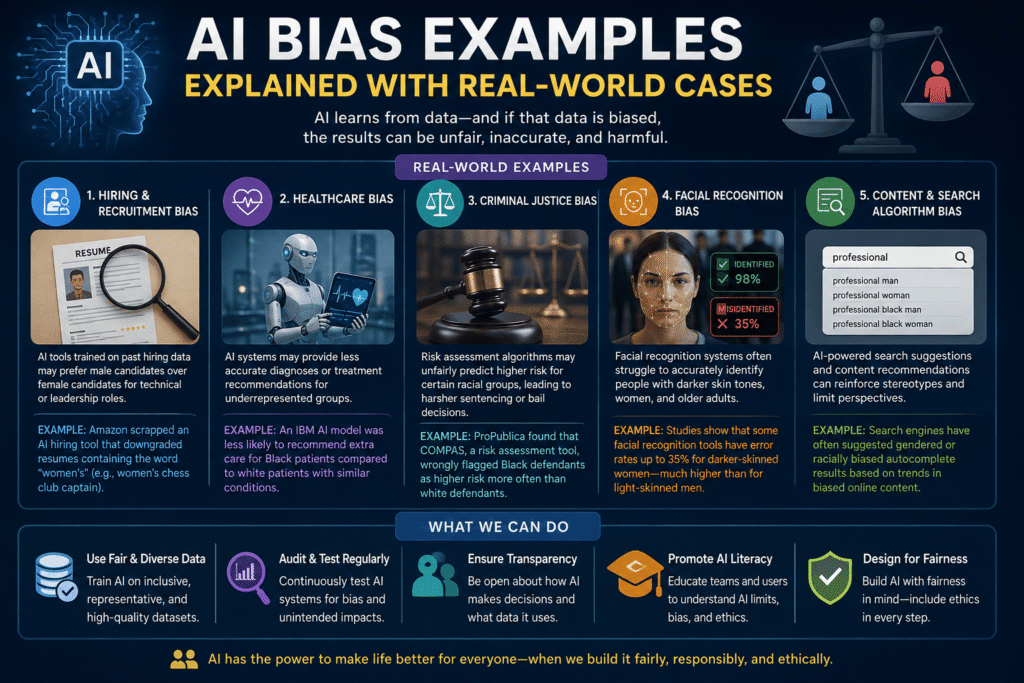
Did you know that an AI system once favored male applicants over equally qualified women simply because of the historical data it learned from?
Artificial intelligence is becoming part of our daily lives. It recommends what we watch, helps doctors diagnose diseases, filters job applications, approves loans, and even assists police departments. But what happens when these systems make unfair decisions?
Understanding AI bias examples is more important than ever because biased AI can affect hiring, healthcare, education, banking, and even criminal justice. Many people assume AI is always objective because computers don’t have emotions. In reality, AI learns from human-created data, and that data often contains hidden biases.
In this guide, you’ll discover what AI bias is, why it happens, real-world examples that made global headlines, and practical ways businesses, developers, and everyday users can reduce its impact. By the end, you’ll understand why building trustworthy AI is one of the biggest challenges—and opportunities—of the modern digital world.
📌 Key Takeaways
✔ AI is not automatically fair—it learns from data created by humans.
✔ Bias can appear in hiring, healthcare, banking, policing, and online recommendations.
✔ Understanding AI bias examples helps businesses build more trustworthy systems.
✔ Responsible AI requires better data, testing, transparency, and continuous monitoring.
Table of Contents
- What Is AI Bias?
- Why AI Bias Matters
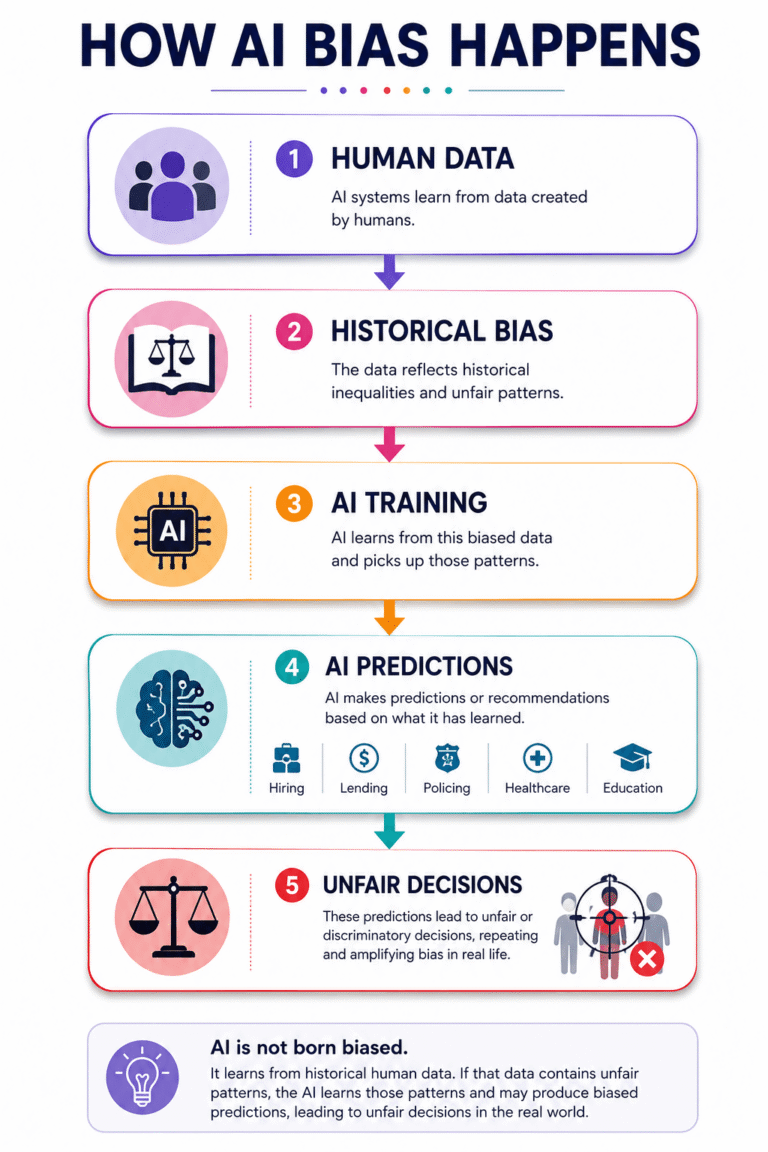
- How AI Becomes Biased
- Real AI Bias Examples
- Types of AI Bias
- Benefits of Detecting Bias
- Best Practices
- Common Mistakes
- Checklist
- FAQ
- Conclusion
What Is AI Bias?
AI bias refers to unfair or discriminatory outcomes produced by artificial intelligence systems because of biased training data, flawed algorithms, or human decisions during development. Instead of making neutral decisions, AI may unintentionally favor or disadvantage certain people or groups.
Imagine teaching a child only one side of history. Naturally, that child develops a limited understanding of the world.
AI works in a similar way.
If an AI system only learns from incomplete, outdated, or biased information, its decisions may also become unfair.
Unlike humans, AI has no personal opinions.
Instead, it reflects the patterns hidden inside its training data.
This is why experts often say:
“AI reflects society—it doesn’t automatically improve it.”
Why AI Bias Matters in the Real World
Artificial intelligence influences millions of important decisions every day. When these systems become biased, the consequences can affect people’s careers, finances, health, and safety.
Consider the following situations:
- A qualified candidate never receives a job interview.
- A patient receives an incorrect medical recommendation.
- A family is denied a mortgage.
- A facial recognition system identifies the wrong person.
These aren’t science fiction stories.
Several have happened in real life.
As AI adoption grows across the USA, Canada, Europe, and the UK, governments and businesses are placing greater emphasis on fairness, accountability, and transparency.
- Industries Most Affected
- Industry Potential AI Bias
- Healthcare Misdiagnosis for underrepresented groups
- Banking Unfair loan approvals
- Hiring Gender discrimination
- Insurance Unequal pricing
- Criminal Justice Incorrect risk assessments
- Retail Biased recommendation systems
- Education Unfair admissions screening
Summary Box
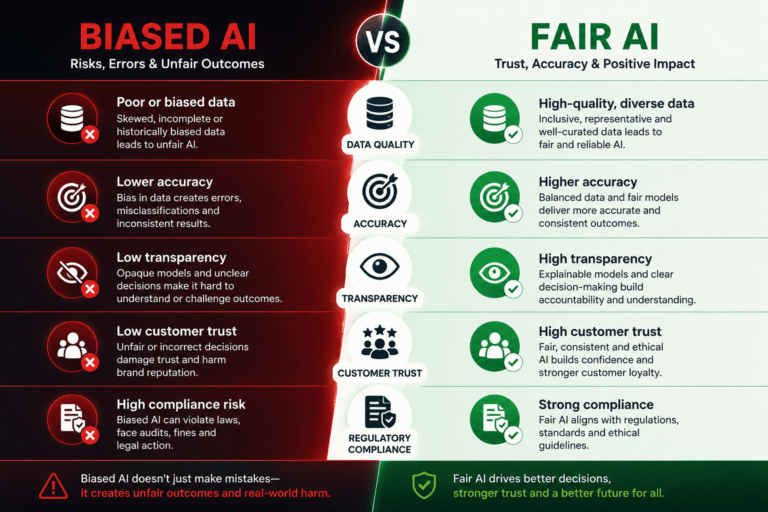
Businesses that fail to address AI bias may face:
- Loss of customer trust
- Legal challenges
- Financial penalties
- Damaged reputation
- Poor AI performance
1. Biased Training Data
The most common cause is biased historical data.
Imagine a hiring algorithm trained on ten years of company hiring records.
If the company historically hired mostly men for engineering roles, the AI may learn that men are “better” candidates—even if women today have equal or better qualifications.
This isn’t intentional discrimination.
It’s learned behavior.
2. Missing Data
Sometimes the problem isn’t bad data.
It’s missing data.
For example, if an AI medical system is trained mainly using data from adults, it may perform poorly when diagnosing children.
Likewise, facial recognition systems trained mostly on lighter skin tones may struggle to identify people with darker skin accurately.
3. Human Design Choices
Developers decide:
- Which data to collect
- Which features matter
- Which outcomes to optimize
- How success is measured
These choices can unintentionally introduce bias.
Even well-meaning teams can overlook important perspectives if they lack diversity or fail to test their systems across different user groups.
4. Feedback Loops
AI often learns from its own predictions.
Suppose a recommendation system promotes only popular products.
Those products receive more clicks.
The AI then concludes they are the “best” products and recommends them even more.
Over time, less popular but high-quality products become nearly invisible.
This creates a self-reinforcing cycle known as a feedback loop.
Real AI Bias Examples That Changed the Industry
Nothing explains AI bias better than real-world cases. These examples show how even advanced AI systems can produce unfair outcomes when trained on biased data or evaluated without enough oversight.
Loan Approval Systems
Many banks and financial institutions use AI to assess credit risk and approve loans. If historical lending data contains unfair patterns, AI may unintentionally disadvantage certain communities.
For instance, if past applicants from a specific region or socioeconomic background were approved less often, an AI model trained on that data could continue making similar recommendations.
Lesson Learned
Financial institutions should regularly audit AI models, remove biased variables, and ensure lending decisions comply with fair lending regulations.
Predictive Policing
Some law enforcement agencies have experimented with AI systems that predict where crimes are more likely to occur.
However, if historical crime data reflects over-policing in certain neighborhoods, AI may repeatedly identify those same areas as “high risk,” creating a cycle of increased surveillance.
Lesson Learned
AI predictions should support—not replace—human judgment. Transparent evaluation and independent oversight are essential.
Generative AI
Modern AI chatbots and image generators learn from enormous datasets gathered from books, websites, and other public sources.
If those datasets contain stereotypes or biased language, the AI may occasionally produce unfair or misleading outputs.
Fortunately, AI companies continuously improve these systems through better data filtering, human feedback, and ongoing testing to reduce harmful bias.
📦 Key Takeaways Box
Remember these three principles:
✔ AI is not born biased—it learns from data.
✔ Better data usually leads to fairer AI.
✔ Human oversight remains essential.
Benefits of Reducing AI Bias
Organizations that actively reduce AI bias gain significant advantages.
Better Decision-Making
Fair AI produces more reliable predictions, helping organizations make smarter business decisions.
Increased Customer Trust
People are more likely to use AI-powered services when they believe the technology treats everyone fairly.
Regulatory Compliance
Countries across Europe, North America, and other regions are introducing AI regulations that emphasize transparency, accountability, and fairness.
Improved Brand Reputation
Companies known for responsible AI often enjoy stronger customer loyalty and greater public confidence.
Higher Model Accuracy
Removing biased data frequently improves overall AI performance because the model learns from a broader and more representative dataset.
Best Practices for Building Fair and Ethical AI
Reducing AI bias requires continuous effort throughout the AI lifecycle.
Step 1: Collect Diverse Data
Gather data from different demographics, regions, age groups, and backgrounds.
A diverse dataset helps AI perform more consistently across populations.
Step 2: Audit Training Data
Review datasets for missing groups, historical inequalities, duplicate records, or inaccurate labels before training begins.
Step 3: Test Across Different Groups
Evaluate model performance using different demographic categories rather than relying on a single overall accuracy score.
Step 4: Keep Humans in the Loop
AI should support human decision-making—not replace it entirely.
Critical decisions involving healthcare, hiring, finance, or law should always include human review.
Step 5: Monitor AI After Deployment
Bias can emerge over time as data changes.
Organizations should continuously monitor AI systems and retrain models when necessary.
💡 Expert Tip
Treat AI like an employee rather than a finished product. Even after deployment, it needs supervision, performance reviews, updates, and regular improvements.
Common Mistakes to Avoid
Avoid these common pitfalls when developing or using AI systems:
- Assuming AI is automatically objective.
- Using outdated or incomplete datasets.
- Ignoring minority populations during testing.
- Focusing only on accuracy instead of fairness.
- Deploying AI without regular audits.
- Removing human oversight from critical decisions.
📖 Real-World Case Study
Case Study: Improving AI Hiring
A large organization noticed that its AI recruitment tool consistently ranked certain applicants lower than expected.
After an internal review, the team discovered that historical hiring records contained imbalances reflecting past recruitment practices.
They addressed the issue by:
- Expanding training data.
- Removing biased indicators.
- Introducing human review for final hiring decisions.
- Regularly auditing model performance.
Result: Hiring recommendations became more balanced, transparent, and aligned with company diversity goals.
Practical Checklist for Responsible AI
Use this checklist before deploying any AI system:
 Collect representative data.
Remove duplicate and inaccurate records.
Test across different demographic groups.
Monitor fairness metrics regularly.
Document AI decisions where possible.
Include human oversight.
Retrain models when data changes.
Follow recognized AI ethics frameworks.
Build Smarter and Fairer AI
AI is shaping the future, but fairness must be part of every intelligent system.
Explore more beginner-friendly AI guides on My AI Study Zone to deepen your understanding of ethical AI, machine learning, and emerging technologies.
If you’re building AI solutions for your business or studies, start with responsible practices today—they’ll benefit both your users and your long-term success.
Frequently Asked Questions (FAQ)
What is AI bias?
AI bias is the tendency of an artificial intelligence system to produce unfair or inaccurate outcomes because of biased data, algorithm design, or human decisions during development.
Why does AI become biased?
AI becomes biased when it learns from historical data that contains existing inequalities, stereotypes, or missing representation of certain groups.
Can AI bias be completely eliminated?
Completely eliminating AI bias is difficult. However, organizations can significantly reduce it through diverse datasets, fairness testing, regular monitoring, and human oversight.
Which industries are most affected by AI bias?
Healthcare, finance, hiring, education, insurance, law enforcement, and retail are among the industries where AI bias can have the greatest impact.
Why are AI bias examples important?
Real AI bias examples help developers, businesses, and policymakers understand potential risks and encourage the creation of more ethical, transparent, and trustworthy AI systems.
Conclusion
Artificial intelligence offers enormous opportunities, but it also carries significant responsibility. The real-world AI bias examples discussed in this guide demonstrate that AI is only as fair as the data and processes used to build it.
Organizations that prioritize fairness, transparency, and continuous monitoring will create AI systems that are more accurate, trustworthy, and beneficial for everyone.
As AI becomes increasingly integrated into our daily lives, understanding and reducing bias is no longer optional—it’s essential for building technology that serves society fairly.