
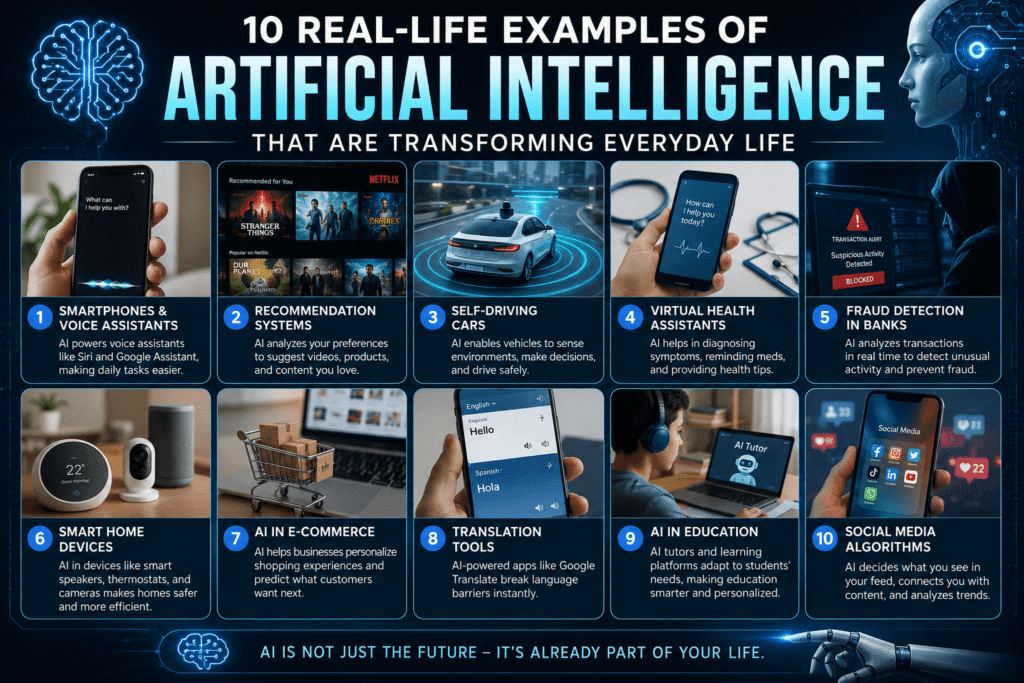
Introduction
Artificial intelligence is no longer limited to science fiction movies or cutting-edge research labs. Today, 10 Real-Life Examples of Artificial Intelligence can be found in the apps we use, the vehicles we drive, the products we buy, and even the healthcare services we receive. AI has become an invisible yet powerful technology that helps businesses make smarter decisions and enables consumers to enjoy faster, safer, and more personalized experiences.
Whether you’re a business owner looking to improve efficiency, a student exploring AI concepts, or a professional preparing for the future of work, understanding how artificial intelligence is applied in real life is more important than ever.
From voice assistants and recommendation engines to fraud detection and medical diagnostics, AI is changing industries across the USA, Canada, Europe, and the UK. As adoption continues to grow, organizations that embrace AI responsibly will be better positioned to innovate, compete, and deliver exceptional customer experiences.
In this comprehensive guide, we’ll explore ten practical examples of artificial intelligence, explain how they work, discuss their benefits, and share best practices for leveraging AI effectively.
Table of Contents
1. Why Artificial Intelligence Matters
2. What Is Artificial Intelligence?
3. How AI Is Changing Everyday Life
4. 10 Real-Life Examples of Artificial Intelligence
5. Benefits of Artificial Intelligence
6. Best Practices for Using AI
7. Common Mistakes to Avoid
8. Practical AI Checklist
9. Internal & External Link Suggestions
10. Call to Action
11. Frequently Asked Questions
12. Conclusion
Why Artificial Intelligence Matters in Today's Digital World
Artificial intelligence is one of the most significant technological advancements of the 21st century. It is transforming the way businesses operate, governments deliver services, and individuals interact with technology.
Unlike traditional software, AI systems can analyze data, recognize patterns, learn from experience, and improve their performance over time. This ability allows organizations to automate repetitive tasks, predict future outcomes, and make informed decisions faster than ever before.
For businesses, AI offers opportunities to reduce costs, improve customer satisfaction, and increase productivity. For consumers, it provides convenience through personalized recommendations, intelligent assistants, smart home devices, and enhanced online experiences.
As industries continue their digital transformation, understanding AI is becoming an essential skill rather than an optional one.
What Is Artificial Intelligence?
Artificial intelligence(AI) is a branch of computer science focused on creating systems capable of performing tasks that normally require human intelligence. These tasks include:
- Learning from data
- Understanding natural language
- Solving problems
- Recognizing speech and images
- Making predictions
- Automating decision-making
Most modern AI applications rely on technologies such as:
Machine Learning
Machine learning enables computers to learn from historical data without being explicitly programmed for every scenario.
Examples include:
- Product recommendations
- Email spam filters
- Fraud detection
- Sales forecasting
Natural Language Processing (NLP)
Natural Language Processing allows computers to understand, interpret, and generate human language.
Popular applications include:
- Chatbots
- Translation software
- Voice assistants
- AI writing tools
Computer Vision
Computer vision enables AI systems to interpret images and videos.
Common examples include:
- Facial recognition
- Medical imaging
- Autonomous vehicles
- Quality inspection in manufacturing
Understanding these technologies makes it easier to appreciate how AI powers many of the tools we use every day.
How Artificial Intelligence Is Reshaping Everyday Life
Many people interact with AI dozens of times each day without even realizing it.
When you unlock your smartphone using facial recognition, receive personalized shopping suggestions, ask Alexa about the weather, or watch a recommended Netflix series, artificial intelligence is working behind the scenes.
Businesses also rely on AI to:
- Analyze customer behavior
- Improve cybersecurity
- Forecast demand
- Automate customer service
- Optimize logistics
- Detect fraud
- Enhance marketing campaigns
This widespread adoption demonstrates that AI is no longer an emerging technology—it is a fundamental part of modern digital infrastructure.
10 Real-Life Examples of Artificial Intelligence
1. Virtual Assistants and Smart Voice Technology
Virtual assistants have become one of the most recognizable applications of artificial intelligence.
Examples include:
- Siri
- Google Assistant
- Amazon Alexa
- Microsoft Copilot
- ChatGPT
These systems use machine learning and natural language processing to understand spoken language, answer questions, set reminders, send messages, and even control smart home devices.
Why It Matters
Virtual assistants save time, improve accessibility, and make technology easier for people of all ages to use. Businesses also leverage AI assistants to improve workplace productivity and automate routine administrative tasks.
2. Personalized Recommendation Systems
Recommendation engines are responsible for many of the personalized experiences people enjoy online.
Whenever Netflix suggests a new movie, Spotify creates a custom playlist, or Amazon recommends products, AI is analyzing your preferences.
AI considers factors such as:
- Previous purchases
- Browsing history
- Viewing habits
- Search behavior
- Customer interests
Benefits
Better customer experiences
Increased engagement
Higher sales conversions
Personalized content delivery
Recommendation engines have become essential for eCommerce businesses, streaming services, and digital platforms because they help users discover relevant content quickly.
3. Artificial Intelligence in Healthcare
Healthcare is one of the industries experiencing the greatest impact from artificial intelligence.
Modern AI systems assist doctors by analyzing enormous amounts of medical data within seconds.
Common healthcare applications include:
- Disease prediction
- Medical image analysis
- Drug discovery
- Patient monitoring
- Personalized treatment recommendations
- Virtual health assistants
AI does not replace healthcare professionals. Instead, it supports faster diagnoses, improves accuracy, and enables clinicians to make better-informed decisions.
For example, AI-powered imaging software can identify subtle abnormalities in X-rays or MRI scans that may be difficult for the human eye to detect.
As healthcare systems continue to adopt AI responsibly, patients benefit from earlier diagnoses, more efficient treatments, and improved outcomes.
4. AI Chatbots and Intelligent Customer Support
Businesses around the world are increasingly using AI chatbots to provide instant customer support.
Unlike traditional scripted chat systems, modern AI chatbots understand natural language and deliver more human-like conversations.
They can:
- Answer frequently asked questions
- Recommend products
- Schedule appointments
- Process simple orders
- Resolve common customer issues
- Escalate complex requests to human agents
Business Benefits
- 24/7 customer service
- Reduced support costs
- Faster response times
- Improved customer satisfaction
- Increased sales opportunities
5. AI Fraud Detection in Banking and Finance
Financial institutions process millions of transactions every day. Monitoring each one manually would be impossible, which is why banks rely on artificial intelligence to detect suspicious activity in real time.
AI-powered fraud detection systems analyze transaction patterns, customer behavior, device information, and geographic locations to identify unusual activity within seconds. If something appears suspicious, the system can automatically flag or block the transaction before financial damage occurs.
Real-World Applications
- Credit card fraud detection
- Identity verification
- Anti-money laundering (AML)
- Risk assessment
- Secure online banking
Why It Matters
AI helps financial institutions reduce fraud losses while providing customers with a safer and more secure banking experience.
6. Self-Driving Cars and Intelligent Transportation
The automotive industry is one of the most exciting areas for AI innovation.
Self-driving vehicles combine artificial intelligence with computer vision, sensors, GPS, radar, and machine learning to understand their surroundings and make driving decisions in real time.
Even if fully autonomous vehicles are not yet common everywhere, many modern cars already include AI-powered features such as:
Adaptive cruise control
Lane-keeping assistance
Automatic emergency braking
Parking assistanc
Driver fatigue monitoring
Benefits
- Improved road safety
- Reduced human error
- Better traffic management
- Lower fuel consumption
- Enhanced driving convenience
As AI technology continues to mature, intelligent transportation systems are expected to play a major role in the future of mobility.
7. Facial Recognition and Biometric Security
Facial recognition has become one of the most widely used AI technologies for identity verification.
Using advanced computer vision algorithms, AI analyzes facial features and compares them with stored data to verify a person’s identity within seconds.
Common Uses
- Smartphone unlocking
- Airport security
- Border control
- Employee attendance systems
- Secure online verification
- Digital payments
Advantages
- Faster authentication
- Improved security
- Reduced identity fraud
- Better user convenience
Organizations should implement facial recognition responsibly while complying with privacy regulations and ethical AI guidelines.
8. Artificial Intelligence in Online Shopping
Online retailers use AI throughout the customer journey to deliver personalized and efficient shopping experiences.
When you browse an online store, AI works behind the scenes to understand your interests and recommend products you are more likely to purchase.
AI Features in eCommerce
- Personalized product recommendations
- Dynamic pricing
- Inventory management
- Customer segmentation
- Smart product search
- Predictive demand forecasting
Business Impact
Retailers using AI often experience:
- Higher conversion rates
- Increased customer loyalty
- Better inventory planning
- Reduced operational costs
- Improved marketing performance
For eCommerce businesses, AI has become a competitive advantage rather than a luxury.
9. AI Language Translation and Communication
Artificial intelligence has transformed global communication by making language translation faster and more accurate than ever before.
Modern AI translation systems understand context instead of simply translating words one by one. This produces more natural and meaningful translations.
Examples
- Website translation
- Email translation
- Live meeting captions
- Voice translation
- Mobile translation apps
Benefits
- Easier international communication
- Better customer support
- Improved accessibility
- Faster global collaboration
Businesses operating across the USA, Canada, Europe, and the UK benefit greatly from AI-powered translation tools that help them reach multilingual audiences.
10. AI Content Creation and Workplace Productivity
Artificial intelligence is helping professionals create content, analyze information, and complete repetitive tasks more efficiently.
Modern AI productivity tools assist with:
- Writing blog posts
- Drafting emails
- Creating reports
- Brainstorming ideas
- Summarizing meetings
- Generating marketing content
- Organizing workflows
Rather than replacing human creativity, AI serves as a powerful assistant that helps professionals work faster and focus on strategic thinking.
Businesses that combine human expertise with AI tools often achieve higher productivity while maintaining quality and creativity.
Benefits of Real-Life Artificial Intelligence Applications
Artificial intelligence offers measurable advantages for individuals, businesses, and organizations across every major industry.
Increased Productivity
AI automates repetitive tasks, allowing employees to focus on innovation, customer relationships, and strategic planning.
Better Decision-Making
By analyzing vast amounts of data in seconds, AI helps organizations make informed, data-driven decisions with greater confidence.
Enhanced Customer Experience
AI personalizes recommendations, improves response times, and delivers more relevant customer interactions.
Improved Accuracy
Whether analyzing medical scans or detecting financial fraud, AI reduces human error and increases precision.
Cost Savings
Automation lowers operational costs while improving overall efficiency.
Stronger Cybersecurity
AI detects unusual patterns, identifies threats, and helps organizations respond to cyberattacks more quickly.
Best Practices for Using Artificial Intelligence Successfully
Adopting AI requires careful planning and responsible implementation.
Follow these best practices:
Define Clear Objectives
Identify the business problem before selecting an AI solution.
Use High-Quality Data
AI performs best when trained with clean, accurate, and relevant data.
Keep Humans in the Loop
AI should support human decision-making rather than completely replacing it in critical situations.
Prioritize Data Privacy
Ensure compliance with regulations such as GDPR and other applicable privacy laws.
Monitor AI Performance
Regularly evaluate AI systems to improve accuracy and minimize bias.
Invest in Employee Training
Equip your team with the knowledge needed to work effectively alongside AI technologies.
Common Mistakes to Avoid When Implementing AI
Many organizations struggle with AI adoption because they overlook key fundamentals.
Avoid these common mistakes:
- Implementing AI without a clear strategy
- Expecting immediate results
- Ignoring data quality
- Over-automating customer interactions
- Neglecting employee training
- Failing to monitor AI performance
- Ignoring ethical and privacy considerations
Successful AI adoption requires continuous improvement, transparency, and responsible governance.
Practical Artificial Intelligence Checklist
Before implementing AI, review this checklist:
 Identify your goals and success metrics.
Understand the problem AI will solve.
Ensure high-quality, well-organized data.
Choose trusted AI platforms and vendors.
Protect customer privacy and sensitive information.
Train employees to work with AI tools.
Measure performance regularly.
Continuously improve and update AI systems.
Ready to Explore the Power of Artificial Intelligence?
Artificial intelligence is reshaping every industry—from healthcare and finance to retail, education, and manufacturing. Whether you’re just beginning your AI journey or looking to expand your knowledge, staying informed is the key to making smarter technology decisions.
At My AI Study Zone, we’re committed to helping beginners, professionals, entrepreneurs, and decision-makers understand AI through practical, easy-to-follow guides and expert insights.